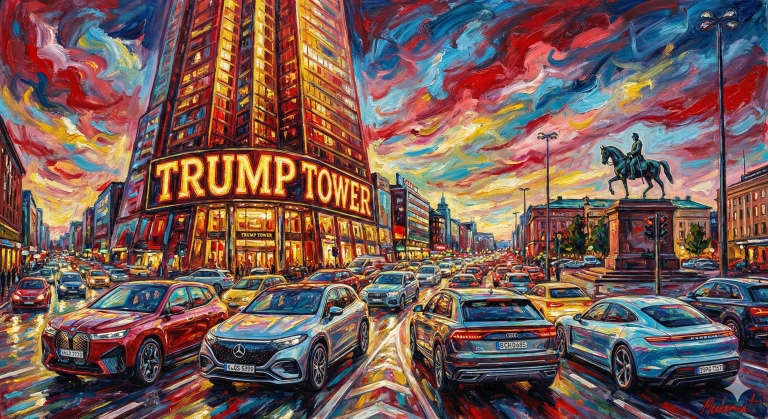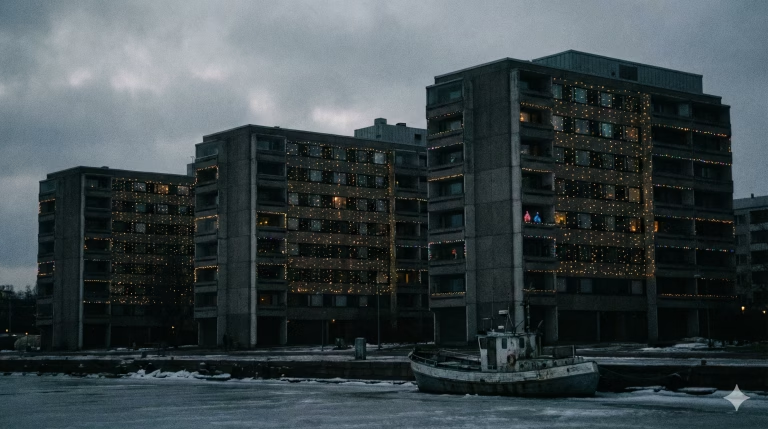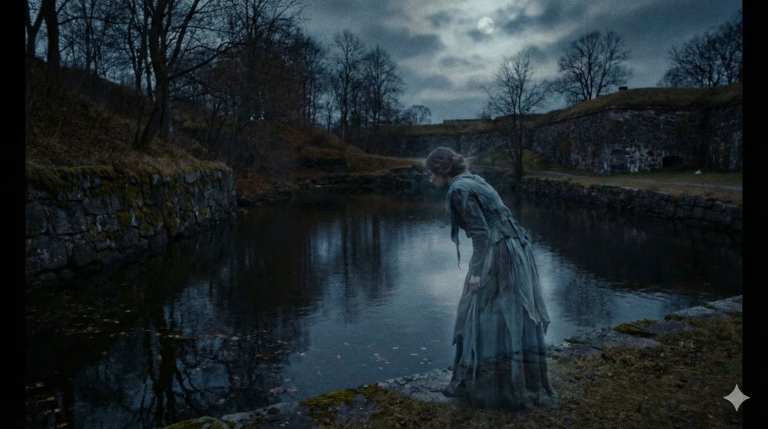
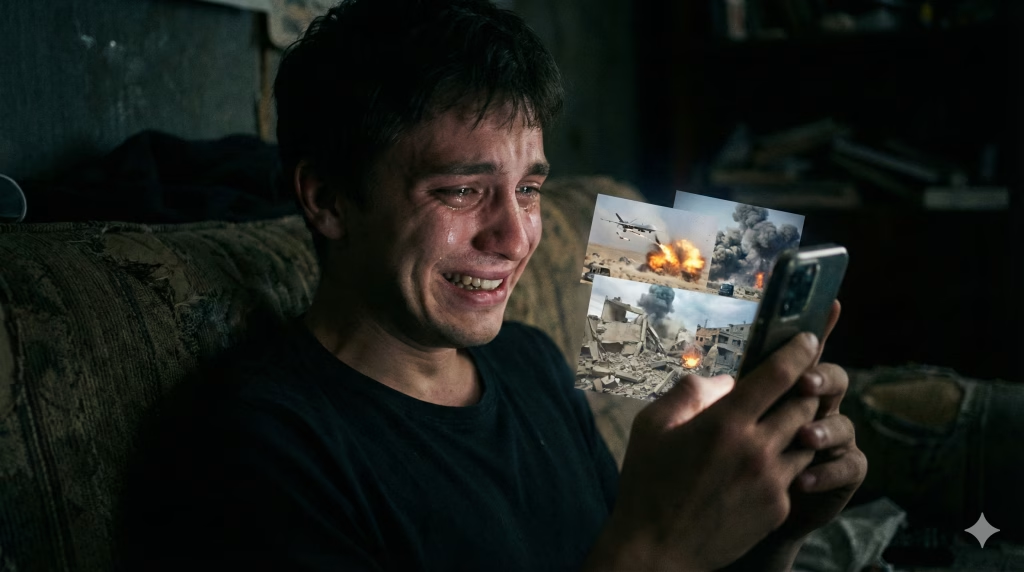
Picture this: It is Tuesday night. You are lying on the couch, scrolling through your phone. A video of a cute golden retriever pops up on the screen. Swipe. Next is graphic footage from the front lines in Ukraine. Swipe. Climate scientists warning of an irreversible tipping point. Swipe. An ad trying to sell you an anxiety-relieving weighted blanket.
Do you feel it? That strange mixture of horror, boredom, and a sense of unreality?
Congratulations. You have just stepped into the world of Kurt Vonnegut.
American author Kurt Vonnegut (1922–2007) died years before TikTok or ChatGPT were invented, but his work feels as if it were written this morning, hungover, while doomscrolling through X (formerly Twitter). Vonnegut was not just a science fiction writer or a satirist; he was a canary in a coal mine who didn’t stop singing even when the gas filled the room. He just switched the tune to laughter.
We are living in a “Vonnegutian” decade, and it is high time we took his lessons seriously.
We Are All “Unstuck in Time”
Vonnegut’s most famous work, Slaughterhouse-Five (1969), tells the story of Billy Pilgrim, a man who has become “unstuck in time.” Billy careens uncontrollably between the firebombing of Dresden in WWII, his mundane life as an optometrist in the present, and a zoo on the planet Tralfamadore.
In 1969, this was a metaphor for Post-Traumatic Stress Disorder (PTSD). In 2025, it is an accurate description of our digital daily lives.
We no longer live in linear time. Algorithms do not recognize chronology. When you “doomscroll” your newsfeed, your brain performs the same time jumps as Billy Pilgrim. One moment you are living in 90s nostalgia, the next you are facing future AI threats, and the third you are plunged back into pandemic-era traumas. The past, present, and future are present simultaneously, compressed into a glowing rectangle in the palm of your hand.
Vonnegut’s answer to this chaos was the famous phrase: “So it goes.”
In the book, the phrase is repeated whenever someone dies—whether it is tens of thousands of victims in Dresden or flat champagne. It sounds cynical, but it is a protective mechanism. If we stopped to mourn every tragedy in the world, we would be unable to function.
In the 2020s, each of us repeats “so it goes” in our minds hundreds of times a day. A wildfire destroys a town? So it goes. AI takes our jobs? So it goes. A new pandemic threat? So it goes.
It is the only way the human psyche can process global pain without collapsing. Vonnegut taught us that numbness is not a sign of heartlessness, but an emergency brake for the mind.
Granfalloons: Or Why Social Media Wars Are Stupid
If Slaughterhouse-Five diagnosed our perception of time, then Cat’s Cradle (1963) rips open our identity politics. In the book, Vonnegut introduces the term granfalloon. It implies “a proud and meaningless association of human beings.”
Vonnegut’s examples of granfalloons were the General Electric Company, the Communist Party, and any nation-state. They are groups that make their members believe they share a higher, common purpose, when in reality they are linked only by coincidence or bureaucracy.
Look around you on social media. The internet has turned into a battlefield of granfalloons. Crypto investors pledging allegiance to a doge meme? Granfalloon. Political bubbles defined solely by who they hate? Granfalloon. Brand loyalty? Granfalloon.
We are desperately looking for an “us” to protect against “them.” Vonnegut laughs at this need. He points out that most things we are willing to fight for online are hollow shells. We are ready to tear each other apart to defend a group we belong to largely by accident.
Ice-Nine and the AI “Paperclips”
However, Vonnegut’s most chilling prophecy (literally) is found in Cat’s Cradle. The instrument of the apocalypse in the book is Ice-Nine, an isotope of water that is solid at room temperature. If even a small crystal of Ice-Nine touches the ocean, all the water in the world freezes in a chain reaction.
In the book, scientists do not develop Ice-Nine out of malice. They develop it because it is an interesting problem to solve. They are “morally neutral.”
This is a perfect analogy for the existential risks of the 2020s. When we talk about AI safety and the fear that AI will turn the world into “paperclips” (or something else uninhabitable for humans), we are talking about Ice-Nine. When we talk about lab-leak viruses or “gain-of-function” research, we are talking about Ice-Nine.
Vonnegut understood that the end of the world will likely not come accompanied by a supervillain’s evil laugh. It will come because some nerd wanted to see if they could do something, without stopping to think if they should. Technology without humanism is suicide, and we are all in the audience.
Are We Just Machines?
In his novel Breakfast of Champions (1973), Vonnegut presents a provocative idea: humans are merely biological machines. We are the sum of chemical reactions, devoid of free will. When we have “bad chemicals” in our brains, we do bad things.
This sounded nihilistic in the 70s. Today, it is commonplace.
The “surveillance capitalism” described by Shoshana Zuboff is based on this very assumption. Social media giants treat us as machines whose behavior can be steered with dopamine hits. When you get hooked on an endless feed, you are not making a free choice. You are a machine reacting to stimuli exactly as a coder in Silicon Valley designed you to.
However, Vonnegut’s “human machine” metaphor was not a condemnation, but an act of grace. If we are machines, it is useless to hate ourselves or each other for our flaws. We are simply broken. As he wrote: “We are here on Earth to fart around, and don’t let anybody tell you any different.”
The Only Rule: God Damn It, You’ve Got to Be Kind
Amidst all this cynicism, black humor, and existential horror, Vonnegut offers one life preserver. It is not found in technology, politics, or religion.
In God Bless You, Mr. Rosewater (1965), the protagonist Eliot Rosewater speaks words that should be framed on the wall of every child (and adult) in the 2020s:
“Hello babies. Welcome to Earth. It’s hot in the summer and cold in the winter. It’s round and wet and crowded. On the outside, babies, you’ve got a hundred years here. There’s only one rule that I know of, babies—God damn it, you’ve got to be kind.”
For Vonnegut, kindness was not soft “niceness.” It was a radical rebellion. In a world that is absurd, cruel, and indifferent—a world where Dresdens burn and algorithms eat our brains—kindness is the only logical counterattack.
It is a conscious decision to see the human being behind the granfalloon. It is a decision not to add to the world’s pain, even if you know you cannot save it.
In the midst of the crises of the 2020s, Vonnegut is the friend sitting next to you in a burning house, lighting a cigarette, and saying, “It’s ridiculously hot in here, isn’t it?” He doesn’t promise to put out the fire. He doesn’t lie and say everything will be fine. But he makes you laugh at the absurdity of the flames, and in that laughter, there is a tiny spark of hope.
And if it all goes wrong? Well, so it goes.