1. Introduction: The Lunch Hour as a National Ritual and a Stage for Consumer Behavior
Finnish society is exceptionally strongly rhythmized around the eleven o’clock lunch. This daily ritual is not merely a physiological necessity or a break from work; it is a complex sociocultural event where biological drives, historical traumas, economic incentives, and social pressure intersect. When a Finn steps through the door of a lunch restaurant and grabs a tray, they step onto a stage where a daily drama between scarcity and abundance is enacted. A central role in this play has been taken by the buffet, or noutopöytä, which has established itself as the cornerstone of Finnish lunch culture—from gas station “stuff-your-face” tables to sophisticated sushi buffets in city centers.
This report delves into the phenomenon colloquially known as “lunch coma” (lounasähky). It is a state where a rational, educated, and health-conscious adult eats themselves into a physiological stupor, even while knowing it will impair afternoon productivity and long-term health. Why does this happen? Why is eating “for the full value” such a deeply rooted behavioral model that it overrides the body’s own satiety mechanisms?
To find the answer, we must look below the surface. We cannot settle for the explanation that the food is good or that people are greedy. Instead, we must analyze Sensory-Specific Satiety as a guiding biological mechanism, deconstruct the intergenerational effects of “clean your plate” upbringing, and examine the lunch voucher system as an economic structure that virtually encourages overeating. In this analysis, the lunch buffet acts as a mirror for the Finnish national character, revealing a deep conflict between Lutheran restraint and modern experience-seeking.
In this report, we combine perspectives from nutritional psychology, sociology, economics, and cultural history into a comprehensive synthesis. The goal is to produce an exhaustive explanation for why a people known for their rule-following and modesty lose control in front of a buffet table.
2. The Biological Imperative: Why Do Our Brains Betray Us at the Buffet?
To understand cultural behavior, we must first understand the biological constraints of the human species. Buffet dining is an environment that is seemingly designed to bypass human natural satiety mechanisms. It exploits our evolutionary vulnerabilities in ways against which mere self-discipline is often a powerless weapon.
2.1 Sensory-Specific Satiety (SSS)
The most central mechanism explaining overeating in a buffet environment is Sensory-Specific Satiety (SSS). This concept, studied for decades by Barbara Rolls and her colleagues, describes a phenomenon where the pleasantness of a food decreases as it is eaten, compared to foods that have not yet been eaten. It is an evolutionary mechanism originally intended to guide humans to eat a varied diet. In nature, a monotonous diet leads to deficiency states, so the brain has evolved to reward variety.
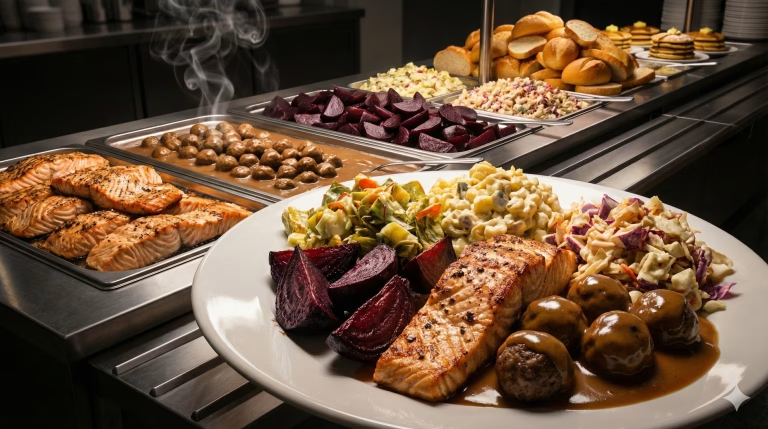
In practice, the mechanism works as follows: When we eat, for example, mashed potatoes and meatballs at a lunch buffet, our sense of taste and our brains habituate to these specific sensations—salty, fatty, and soft texture. The pleasure-producing dopamine response weakens with each bite. In a normal single-dish meal, this would lead to a feeling of satiety and the cessation of eating. However, in a buffet environment, the situation is different. When the diner turns their gaze and sees lasagne, sushi, or fresh salad in the adjacent dish, sensory-specific satiety does not apply to these new stimuli. The new taste, new texture, and new appearance “reset” the feeling of satiety for that specific food.
This explains why a Finnish diner is capable of going for “seconds” of a completely different dish, even if the stomach is physically full. The stomach is full of meatballs but “hungry” for lasagne. Studies have shown that people eat up to 60% more energy at a meal consisting of several different dishes compared to a meal with only one food. The Finnish lunch buffet, which typically includes a salad bar, soup, several warm food options, a bread table, and dessert coffee, is an optimal environment for activating the SSS mechanism.
2.2 Habituation and the “Buffet Effect”
Sensory-specific satiety is strongly linked to habituation, or getting used to something. Habituation is a basic property of the nervous system: the response to a repeated stimulus weakens over time. In dining, this means that the first bite is always the best, and the tenth bite produces significantly less pleasure. The brilliance—and deceptiveness—of buffet dining lies in the fact that it prevents habituation from happening by constantly offering new stimuli.
This phenomenon is called the “Buffet Effect.” Both animal and human experiments consistently show that food consumption increases linearly as the variety on offer increases. This has also been observed in the Finnish context: when a wide variety of foods is available, an individual’s ability to regulate energy intake weakens significantly. The Buffet Effect applies not only to taste but also to the appearance, shape, and color of food. A colorful salad bar, reddish oven-baked salmon, and brown meatballs create visual stimulation that maintains appetite longer than a monochromatic meal.
The following table illustrates the difference between physiological satiety and sensory-specific satiety in a buffet context:
| Feature | Physiological Satiety (Homeostatic) | Sensory-Specific Satiety (Hedonic) |
|---|---|---|
| Trigger | Stomach distension, hormonal signals (e.g., leptin, ghrelin) | Sensory perception of new food (taste, smell, appearance) |
| Effect on eating | Signal to stop eating completely | Signal to stop eating a specific food, but continue eating others |
| Role in buffet | Often ignored or recognized too late | Dominant mechanism maintaining eating |
| Evolutionary reason | Regulation of energy balance | Ensuring varied nutrient intake |
2.3 Passive Overeating and the Obesogenic Environment
The buffet environment can be described as obesogenic, or promoting obesity. Overeating in this environment is rarely conscious gluttony; it is rather “passive overeating.” Passive overeating is a state where an individual eats too much without noticing, without an active decision. It is a reaction to environmental cues rather than internal hunger.
A Finnish lunch restaurant is full of these cues:
- Visual abundance: Food is displayed in large containers, creating an illusion of abundance and permissibility.
- Easy availability: Food is ready, chopped, and portionable without waiting or effort.
- Social modeling: We see colleagues piling their plates high, which normalizes large portion sizes.
- Plate size: Buffet plates are often large, tricking the eye into underestimating portion size (Delboeuf illusion).
In a study investigating the effect of a multisensory environment on dining, it was found that environmental factors significantly influence emotional states. In a Finnish study, subjects more often chose the term “happy” to describe their state in a multisensory buffet environment. This positive emotional association reinforces the behavior: the buffet is not just a place for nutrition, but a momentary oasis of happiness and pleasure in the middle of the workday. This hedonic dimension makes overeating rewarding in the short term, even if the long-term consequences (coma, weight gain) are negative.
3. Historical Heritage: From Famine Years to the Illusion of Abundance
Although biological mechanisms are universal, Finnish lunch behavior is deeply tied to national history. Finland’s history is a survival story where food has traditionally represented safety and life, and its lack, death. This historical burden does not disappear in one or two generations; it lives on in cultural practices and attitudes.
3.1 The Long Shadow of Scarcity and Genetic Memory
Finland is a relatively young welfare state where hunger is still present in collective memory. The Great Famine (1866–1868), during which about eight percent of the population died, has left a permanent scar on the national identity. Additionally, the wars of the 20th century and the subsequent rationing period have taught Finns to value food as a resource that must not be wasted.
Ritva Kylli’s work on Finnish food history describes how food culture has changed from the scarcity of peasant tables to the present day. In peasant culture, eating was functional fueling for heavy physical labor. Food was eaten when it was available, and it was eaten as much as possible because there were no guarantees for tomorrow. This mentality of “stockpile eating” has transferred surprisingly stubbornly to the lunch behavior of modern office workers. Even though energy needs have radically decreased with sedentary work, the cultural code still urges one to “eat heavily.”
The buffet situation activates a subconscious preparation mechanism. When unlimited food is available for a fixed price, the historical fear of scarcity turns into hoarding. This is not a conscious thought of famine, but a deeply rooted instinct that says available nutrition must be utilized maximally.
3.2 The Evolution of Lunch: From Packed Lunches to Workplace Cafeterias
Finnish lunch culture has undergone a dramatic structural change over the last hundred years. The original lunch in agrarian society and early industry was a simple meal—potatoes, bread, salted fish, or pork sauce—consumed during work. After World War II, as industrialization accelerated and women entered the workforce, workplace dining began to institutionalize.
Workplace cafeterias became part of Finnish social policy and occupational well-being. Lunch was no longer solely the individual’s responsibility; society and employers began to support it. This created a tradition of “institutional dining,” which starts in daycare and continues through school and student years into working life. A Finn learns to eat from a tray, queue for food, and choose portions from a line.
This institutional background has created the foundation for the current buffet culture. The buffet is not exotic to a Finn; it is a natural continuum of the school lunch line. The difference is that at school, the cook rationed the number of meatballs (“five pieces per student”), but in a commercial lunch buffet, there are no limits. When external control is removed, but the internal “refueling model” is still in effect, the result is overeating.
3.3 “Man Food” and Agrarian Tradition in the Modern City
Although food culture has become internationalized with sushi and tacos, traditional Finnish “man food” (äijäruoka) holds its ground in the lunch market. Gas station buffets offering schnitzels, mash, and cream sauces remain hugely popular. This reflects a longing for unpretentious, filling food that resonates with agrarian history.
A food tourism brochure for the Seinäjoki region advertises “eating for the full value” and “delicious buffets”, underlining that abundance and a full stomach are still central values in Finnish food culture. In provincial lunch tables, modern health discourse meets the traditional ideal of hospitality, where running out of food would be the greatest possible shame. This aesthetics of abundance is a direct counter-reaction to historical scarcity.
4. “Clean Your Plate” – The Psychodynamics of Upbringing and Trauma
Finnish lunch buffet behavior is not merely biological or historical; it is strongly linked to upbringing and norms learned in childhood. “Clean your plate” is an imperative that still echoes in the minds of adult Finns at the lunch table.
4.1 Intergenerational Trauma and Moral Obligation
The upbringing of the baby boomers and their children included a strong moral obligation to respect food. Leaving food on the plate was seen not only as waste but also as a sin. In the 1960s and 70s, this was often justified by global inequality, such as the Biafran famine. A child was told: “Eat your plate empty, the children in Biafra are hungry.” Although the logic is flawed—a Finnish child eating does not help a starving African—the message got through: leaving food is morally wrong and a sign of a lack of empathy.
This has created a strong ethical charge around eating. The cessation of eating is not based on the feeling of satiety (internal signal), but on whether the plate is empty (external signal). When this behavioral model is transferred to a buffet environment, where portion sizes are defined by oneself but often “the eyes are bigger than the stomach,” a conflict arises. The diner may have greedily piled too much food on the plate. When satiety strikes halfway through, the “clean your plate” programming activates. Food cannot be left because it would produce guilt. The consequence is forced eating, where the last bites do not produce pleasure but physical malaise, yet mental relief from fulfilling the duty.
4.2 Food Waste and Ecological Guilt
Today, the “clean your plate” ethos has gained a new, ecological justification. Food waste is a major environmental problem, and awareness of it has grown. This is principally a positive thing, but in a buffet situation, it can turn against health.
In buffet dining, leftover food typically cannot be packed to go (unlike à la carte portions, for which one can ask for a “doggy bag”). The diner is thus faced with a choice: either throw the food into bio-waste (causing ecological guilt) or eat it themselves (causing physiological harm). Studies suggest that a large proportion of people choose the latter. The body acts as a “bio-waste container” where excess food is placed in the name of a good conscience.
This behavior is particularly contradictory when considering the studies by Anna Sofia Salonen and Milja Pollari on food waste and intergenerational tensions. Older generations emphasize respect for food, while younger ones may be more aware of health limits, but the waste discussion still creates pressure to “destroy” all food taken on the plate.
4.3 Disturbance of Eating Behavior and “External Eating”
Prolonged adherence to external cues (plate emptiness, time of day, company eating) instead of internal cues (hunger, satiety) can lead to disturbed eating behavior. Studies have identified the concept of “external eating,” which is common in buffet behavior.
Adults raised in the Finnish “clean your plate” culture may have lost their sensitivity to recognize satiety. They eat according to visual signs. In a buffet, where visual signs (full platters) never end, this easily leads to uncontrolled eating. As Minttu Poutanen’s article in Weight Watchers magazine describes, overeating has shifted from a deadly sin (gluttony) to an everyday phenomenon explained away by hurry, stress, or simply the good taste of food.
5. Economic Rationality and Its Distortions: The Power of the Lunch Voucher
Finns are famously rational consumers who look for the best price-quality ratio. However, at a lunch buffet, this rationality turns into irrational action due to economic structures and psychological distortions.
5.1 Commodity Theory and the Illusion of Scarcity
Commodity Theory, known in psychology, suggests that the value of a commodity increases when its availability is limited or when it is perceived as a valuable resource. Although food is unlimited in a buffet, the monetary input is a fixed and limited resource.
When a Finn pays, for example, 13.50 euros for lunch, they perform a quick calculation in their mind. For the transaction to be profitable, they must consume commodities (food) worth at least that amount. If they were to eat only a small salad, the raw material cost of which is negligible, they would feel cheated—”the house wins.” By eating “for the full value,” they feel they are beating the system.
This leads to the commodification of stomach capacity. Eating becomes an economic transaction where the goal is to maximize the benefit received. This is particularly visible with expensive ingredients. Sushi buffets are an excellent example of this. Since salmon and shellfish are perceived as expensive, they are hoarded on the plate in disproportionate amounts. The customer optimizes the “perceived value” by maximizing the amount of expensive proteins, often at the expense of their own physical well-being.
5.2 The Lunch Voucher System as an Engine of Overeating
The Finnish lunch benefit system (Edenred, Epassi, Smartum) is a unique institution with a huge impact on eating habits. The tax authority has defined limits for the lunch benefit (in 2025, the lower limit approx. €8.50 and upper limit approx. €13.50). The employer subsidizes the lunch, but the employee pays part of it as taxable value.
This system creates several psychological biases:
- “Use it or lose it”: The lunch voucher is currency that is valid only for food and must be used within a certain time. This encourages using the benefit regularly, even when one’s own packed lunch or a lighter lunch would suffice.
- Price floor: Since the lunch benefit has a minimum value, it makes no economic sense to buy just a 5-euro soup or sandwich with a lunch voucher. This steers consumers towards more expensive—and often heavier—buffet options that are priced right around the maximum value of the lunch benefit.
- Acquired benefit: A tax-subsidized lunch is perceived as an acquired benefit. Failing to utilize it would feel like a pay cut.
According to a study by Oxford Research, the lunch benefit brings an additional demand of 70 million euros to the restaurant industry and 25 million euros in tax revenue to the state. Economically, the system is a success that employs people and keeps the economy running. From a public health perspective, however, it is a double-edged sword. It encourages eating restaurant food, which is often more energy-dense and salty than home-cooked food. The state thus, in a way, subsidizes citizens’ overeating with tax funds, while health authorities try to campaign against obesity.
The following table summarizes the economic effects of the lunch benefit:
| Effect | Value (estimate) | Significance |
|---|---|---|
| Additional demand for restaurant industry | +70 million € / year | Vital support for restaurants, maintains extensive buffet offering. |
| Benefit to the state | +25 million € / year | Tax revenue and employment effects exceed the cost of tax support. |
| Cost of tax support to the state | -17 million € / year | An investment that pays for itself economically. |
| Net effect | +8 million € / year | Economically profitable, but health effects are not included in the calculation. |
5.3 “As Much As the Belly Can Hold” – Marketing and Consumer Promise
Restaurants understand the psyche of the Finnish consumer and exploit it in their marketing. Expressions like “eat as much as you can” or “for the full value” are not just slogans, but promises. They appeal directly to the consumer’s desire to win in the transaction.
A question on the Kirjastot.fi service ponders why the word “buffet” is nowadays associated specifically with unlimited eating: “as much as the belly can hold”. This linguistic association reveals that for many, the primary function of a buffet is not a gastronomic experience, but quantitative maximization. Quality is secondary, as long as the quantity is sufficient to guarantee that hunger does not surprise before evening—or the next morning.
6. The Rhythm of Working Life and Physiological Collapse: The Price of Lunch Coma
Lunch should be a moment when the employee recharges their batteries and recovers from the morning’s load. Paradoxically, the Finnish buffet lunch often leads to the opposite result: physiological collapse and a drop in alertness.
6.1 Postprandial Somnolence or “Food Coma”
When a person consumes a large, carbohydrate- and fat-rich meal—a typical buffet lunch—a powerful physiological process begins in the body. Blood flow is directed to the digestive system (postprandial hyperemia), and the parasympathetic nervous system is activated. This “rest and digest” state is the opposite of the sympathetic nervous system’s “fight or flight” state, which intensive work often requires.
The consequence is drowsiness, lapse in concentration, and a decline in cognitive performance. In colloquial language, one speaks of “food coma” or “lunch coma” (lounasähky). From the perspective of the Institute of Occupational Health and nutritional recommendations, lunch should support alertness, but at a practical level, a heavy buffet meal acts like a sedative.
This is particularly harmful for sedentary experts. Their energy expenditure is low, but their brains would require steady blood sugar. The blood sugar spike caused by a buffet lunch and the subsequent steep drop (insulin response) make the first hours of the afternoon an inefficient “struggle for survival”.
6.2 Social Pressure and “Eating with the Herd”
Workplace dining is rarely an individual performance; it is a social ritual. When the whole team goes to lunch together, individual freedom of choice narrows. Social pressure affects on many levels:
- Choice of place: If the majority wants a “stuff-your-face buffet,” the one craving a lighter option has to adapt.
- Social facilitation: Studies show that people eat more in a group than alone. Others eating acts as a visual cue and permission to eat more oneself.
- Adherence to norms: In a Finnish work community that values equality and modesty, deviant eating behavior (e.g., just a salad or own packed lunch) may attract attention. “Doesn’t the food taste good?” or “Are you on a diet?” are questions many want to avoid, so it is easier to eat “normally,” i.e., heavily.
An article by Antell emphasizes that it would be worthwhile for the employer to support a high-quality lunch to improve alertness. However, if the benefit offered by the employer (lunch voucher) steers employees towards a heavy buffet, the goal turns against itself.
6.3 Stomach Troubles and IBS – A National Disease at the Buffet Table
The consequences of overeating are not just fatigue. Nutritionist Reijo Laatikainen highlights the prevalence of Irritable Bowel Syndrome (IBS) and stomach troubles. Buffet food often contains a lot of so-called FODMAP carbohydrates (e.g., onions, wheat, beans) and fat, which are poison for a sensitive stomach.
“Lunch coma” is often also physical pain and bloating. However, Finns tolerate this symptomatology for an amazingly long time. It is part of the “culture of suffering” or silent acceptance: a good lunch takes its toll. Physiological discomfort is the price paid for momentary hedonic pleasure and economic “victory.”
7. Buffet Types and Tribes – From Sushi to Pork Sauce
The lunch buffet is not a monolith but has differentiated into various subcultures serving different population groups and needs. These “tribes” tell their own story of the change in Finnish society.
7.1 Sushi Buffet – The New National Dish and the Choice of the Middle Class
The lunch scene in Helsinki and other large cities is nowadays dominated by sushi buffets. In “Best Lunch in Finland” votes, sushi restaurants are at the top. This is a fascinating phenomenon in a country whose traditional food culture is based on root vegetables and cooked meat.
Why does the sushi buffet appeal to Finns?
- Illusion of healthiness: Sushi is perceived as fresh, light, and healthy (“it’s just fish and rice”). This reduces the guilt of overeating. In reality, sushi rice is seasoned with sugar and vinegar, and buffet sushi often contains mayonnaise, making the energy density high.
- Prestige: As mentioned earlier, salmon is a valued ingredient. An unlimited amount of salmon is perceived as luxury.
- Ease: Finger food is easy to eat, and small pieces trick the brain (“I’ll take just one more”).
The sushi buffet is the choice of the modern, urban knowledge worker. It represents internationalism and status but at the same time satisfies the traditional need to eat one’s fill for a fixed price.
7.2 Gas Station Buffet – The Common People and “Real Food”
At the other extreme are the traditional buffets of ABC stations and lunch restaurants. Here, meatballs, mash, schnitzels, and casseroles are on offer. This is “honest food” (comfort food) that appeals to a sense of security.
These buffets serve especially those doing physical work and residents of the provinces. They are modern equivalents of the feast tables of farmhouses of the past. According to S Group statistics, festive buffets attract tens of thousands of diners, indicating that the buffet is still the highlight of Finnish celebration and everyday life. It is a place where one can be oneself and eat as much as one wants without pretension.
7.3 Health Buffet – Pippa Laukka’s Ideal vs. Reality
The third category is the “healthy buffet,” represented by salad-focused lunch places. Experts, such as Pippa Laukka, emphasize that one can assemble a healthy meal from a buffet. Correctly assembled, a buffet lunch is nutritionally superior compared to a fast-food meal.
The problem, however, is human behavior. Even if healthy options are available, sensory-specific satiety and old habits often guide one to choose heavier options or to eat salad as a side dish rather than a main course. A healthy buffet requires active self-discipline and conscious choices from the diner, whereas a “stuff-your-face buffet” requires only surrendering to instincts. A tired employee often chooses the easier path.
8. Health Discourse vs. Reality: Why Doesn’t Education Work?
Finland has high-level nutritional expertise, and official recommendations are clear. The National Nutrition Council and THL publish recommendations for working-age dining. Why do these recommendations not materialize on the lunch line?
8.1 The Gap Between Knowledge and Action
Finns are very health-conscious. We know what the plate model is and why vegetables should be eaten. Yet, knowledge does not turn into action in a buffet situation. This is because eating is rarely a purely rational activity. It is emotional, social, and impulsive.
Health education appeals to cognition (reason), but the buffet appeals to the limbic system (emotions and drives). When tired, stressed, or hungry, the limbic system wins. “I know I should eat salad, but I want lasagne.”
8.2 Harsh Performance Society and Food as Comfort
Finnish working life is demanding and performance-oriented. The dark climate and long winter create their own challenges for mood. In this context, food is one of the few permissible, easily accessible, and socially acceptable pleasures.
Alcohol use has been restricted and smoking has decreased, but eating is still a permitted vice. The lunch buffet offers momentary relief, a dopamine spike in the middle of gray everyday life. It is a reward for the morning’s toil. Overeating is thus also self-medication; a way to numb stress and seek comfort.
9. Conclusions: The Lunch Buffet as a Mirror of National Character
The analysis shows that “the psychology of the lunch buffet” is much more than just a question of food. It is a cross-section of Finnishness where the past and present collide.
What does this phenomenon tell about the national character?
- Trauma and survival: The Finn still eats as if preparing for winter or a time of shortage. The genetic memory of famine years and wartime scarcity have encoded in us the command: “Eat when it is available.” This survival strategy has turned into a health risk in the welfare society.
- Rule-following and sense of duty: “Clean your plate” is a deeply rooted norm. The Finn is obedient to their upbringing and feels a moral obligation not to waste, even if it means using their own body as a waste container.
- Pragmatic economy: The Finn is a “homo economicus” who counts cents even on the lunch line. Maximizing the lunch voucher is a national sport. We do not tolerate the thought of paying for “nothing” or getting less than others.
- Latent hedonism: Under the surface smolders a need to let loose. The stoic and reserved people find in the buffet a permissible carnival, an island of abundance where one is allowed to be greedy and enjoy limitlessly for a moment.
- Power of institutions: We trust the system. If the state supports lunch with a tax deduction and the employer offers a voucher, we feel that we are supposed to use it. Lunch is not just a private matter, but part of the social contract.
Finally: Lunch coma is a Finnish paradox. It is an irrational act by a rational person, repeated day after day. It is a silent rebellion against the Protestant work ethic—a moment when the employee makes themselves (momentarily) incapacitated for work, and society accepts it with a silent nod. The buffet is a microcosm of modern Finland: a mixture of agrarian tradition, industrial efficiency, market economy logic, and human weakness, all served from a standing table at the price of 13.50 euros.