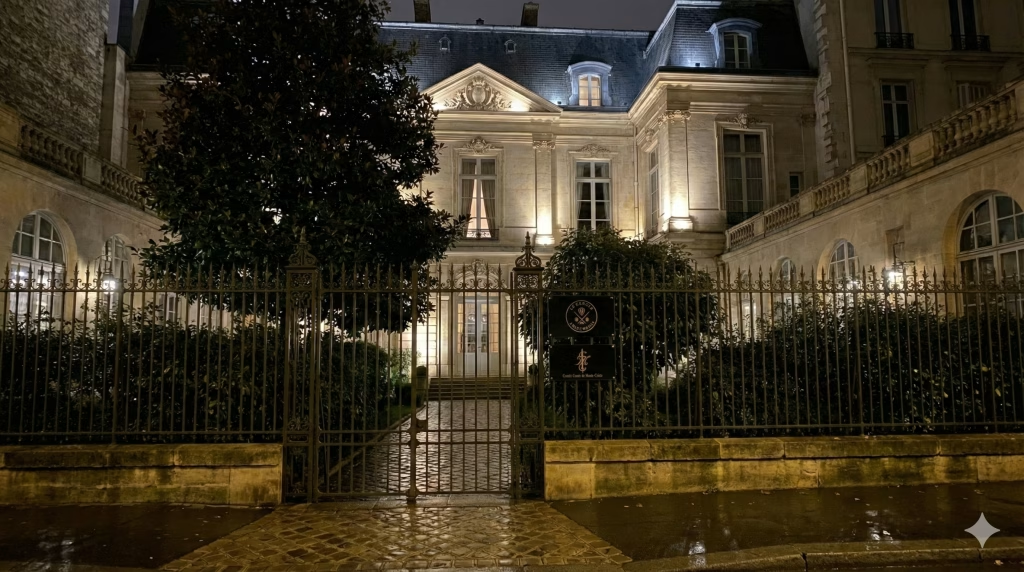
March 7, 2015. An evening in Paris. I am standing at 2 Rue Gaston-Gallimard, in one of the city’s most prestigious districts. Before me loom heavy wrought-iron gates, and behind them, sheltered by a garden, stands a private palace: Hôtel de La Salle.
The signs on the gate exude aristocratic authority: Le Cercle Aristophil and Comité Comte de Monte-Cristo.
But in March 2015, the golden letters on these signs no longer symbolized success and wealth. They were a tombstone for one of the largest, most peculiar, and most sophisticated frauds in French history.
This is the story of Aristophil—the “Madoff of pens and paper”—and how a love for literature was harnessed into a billion-euro pyramid scheme.
Part 1: The Resurrection of Monte Cristo
At the center of the story is a man named Gérard Lhéritier. He was not your typical financial shark. He was a passionate collector, a self-taught expert who loved history.
Lhéritier’s business idea was ingenious. In 1990, he founded Aristophil. The premise was simple: rare manuscripts, letters, and musical scores are valuable, but ordinary people cannot afford Napoleon’s love letters or Einstein’s drafts on the theory of relativity.
Lhéritier broke these treasures down into parts. He sold investors “shares” in the manuscripts. The promise was intoxicating: 8–9 percent annual returns. After five years, Aristophil would buy the shares back at a higher price.
The name Comité Comte de Monte-Cristo was not chosen for the narrative by chance. Lhéritier was obsessed with Alexandre Dumas’ classic. He bought the novel’s original manuscript for a record price. He saw himself as Edmond Dantès—an outsider who had clawed his way into the Parisian elite to exact revenge on those who doubted him. He established the committee to cherish this legacy.
Like the Count of Monte Cristo, Lhéritier lived large. The palace on Rue Gaston-Gallimard was filled with history, and Lhéritier himself was a cultural patron to whom the directors of the Louvre and the National Library bowed.
Part 2: The Illusion of Perfection
For years, the machine worked like a dream. Aristophil hoarded the world’s finest papers:
The scroll manuscript of the Marquis de Sade’s 120 Days of Sodom.
Sketches of The Little Prince.
General de Gaulle’s London radio speeches.
Eventually, there were about 18,000 investors. They were not just millionaires, but ordinary French retirees investing their savings in a “safe haven”—cultural heritage that would not fluctuate with stock market prices.
But behind the scenes, a problem was smoldering. For Lhéritier to pay old investors their 8% returns and buy back their shares, he constantly needed new money coming in.
Furthermore, the prices of the manuscripts were a bubble. Aristophil would buy a work at auction (often already at a high price) and “revalue” it in their own books at many times the cost so it could be sold in shares to investors. The market price was artificial because Aristophil was the market.
Part 3: Raid at Dawn
The bubble burst in November 2014. The blue lights of police cars flashed against the grey dawn at the gates of Rue Gaston-Gallimard. The French anti-fraud squad and financial police raided the Hôtel de La Salle.
Gérard Lhéritier was arrested. Accounts were frozen.
It was revealed to be a classic Ponzi scheme. The money did not come from the appreciation of manuscripts, but from the pockets of new investors. The collections were valued at hundreds of millions on the books, but on the free market, their worth was only a fraction of that.
Part 4: March 2015 – The Silent House
By March 2015, the drama had moved to the courtrooms, but its traces were still fresh.
Le Cercle Aristophil (the sign above) was dissolved. The investors’ club, where champagne had been sipped while admiring Voltaire’s letters, was closed.
The doors of the house were bolted. Inside, thousands of manuscripts waited for their fate in seizure, gathering dust in dark vaults.
Meanwhile, thousands of investors realized they had lost everything. Many had invested hundreds of thousands of euros. The “sure investment” had evaporated like smoke.
Part 5: The Aftermath – The Auction of the Century
The story did not end in bankruptcy. What followed was one of the largest logistical operations in history: the liquidation of the Aristophil collections.
The legal battles dragged on for years. Finally, it was decided that the only way to recover even some money for the victims was to sell the collection. Starting in 2017, a series of auctions known as “Collections Aristophil” began.
The auction house Aguttes has been selling treasures for years. The market was flooded with rarities.
De Sade’s 120 Days of Sodom was declared a National Treasure, and the French state purchased it for museum collections.
While tens of millions have been raised from the total pot, it is merely a drop in the ocean compared to the nearly one billion euros that investors lost.
Epilogue
I stand at the gate of the palace at 2 Rue Gaston-Gallimard at a moment when the dream was already dead, but the body was still warm.
Lhéritier, that modern Monte Cristo, did not get his revenge, but disgrace. He denied his guilt to the end, claiming to be a misunderstood visionary. For the investors, the stone house on Rue Gaston-Gallimard no longer represents culture, but a monument to greed and blind faith.
The signs have since been unscrewed. But that evening, on March 7, 2015, they still gleamed in the Paris night, lying until the very end.