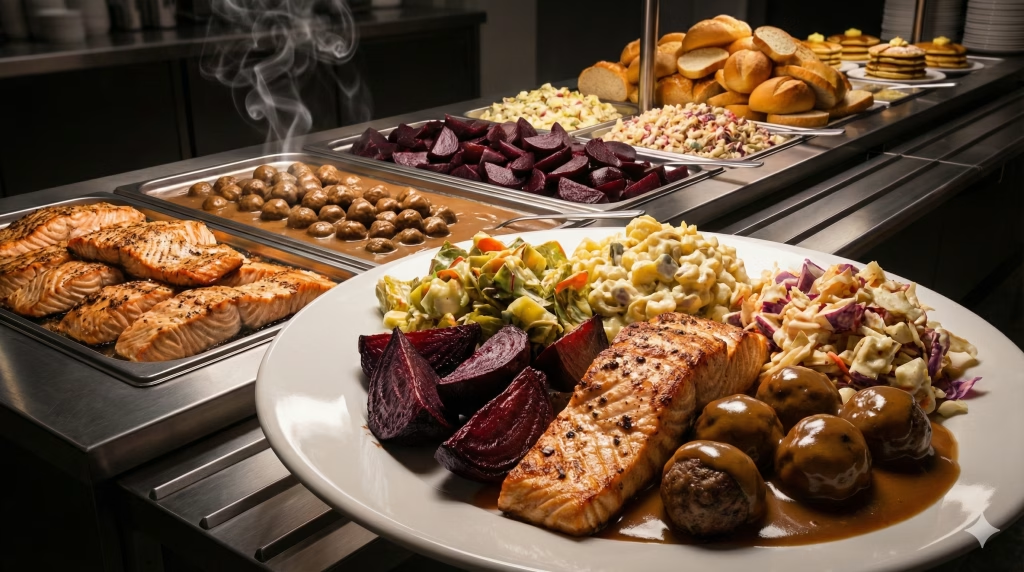
I am standing in the line at a Finnish workplace cafeteria, and the sight opening up before me is simultaneously grotesque and hypnotic. On offer, there is overcooked oven-baked salmon, meatballs swimming in brown sauce, wedges of beetroot, three varieties of salad, a mountain of bread, and oven pancakes for dessert. I stare at this ocean of carbohydrates and fat in despair, and only one question hammers in my mind: Is it mandatory to eat all of this?
The answer is apparently yes. I look around. My colleagues, those rational and highly educated experts, are piling their plates high as if there were no tomorrow. This is not lunch; this is a battlefield. And we are losing the war against our own biology.
Brain Off, Belly Full
We think we make choices, but in reality, we are just lab rats led by our instincts. The analysis is merciless: the lunch buffet is a rigged trap that bypasses our self-control. The culprit is “sensory-specific satiety”—that cruel joke of evolution that makes us crave lasagne the moment we are full of meatballs. The stomach screams for mercy, but the brain screams, “New flavor, new pleasure!”
And we obey. We go for seconds, even though we know exactly where it leads. The “lunch coma” that strikes at 1 PM is not an accident; it is a physiological punishment for letting cheap dopamine defeat reason. Afternoon productivity is sacrificed for a food coma that turns offices into wandering zones for zombies.
Ghosts of the Famine Years and the Curse of the Voucher
But this isn’t just about biology. A Finnish trauma echoes in this gluttony. We eat as if the famine years were still at the door. The “clean your plate” upbringing has implanted a deep guilt in us: food must not be thrown away, so our body must act as a bio-waste container. It is better to feel physically ill than to feel a moral hangover about waste.
And then there is the money. Oh, the holy lunch voucher! That gift from the taxman that has completely distorted our relationship with food. When we pay 13.50 euros for lunch, our inner accountant wakes up. If we eat only a salad, “the house wins.” Therefore, we must eat “for the full value.” We stuff ourselves with cheap bulk food to maximize theoretical gain, all while destroying our own health. It is ingenious: the state uses tax money to subsidize a system that feeds the nation until it is sick and inefficient.
Stop the Stuffing
It is time to stop the self-deception. The lunch buffet is not “well-being” or a “social moment.” It is a relic of the agrarian age that does not suit modern knowledge work. It is an environment where a civilized human regresses into a hoarder.
The next time you stand in that line, ask yourself: Are you eating, or are the ghosts of the famine years and the tax incentives eating on your behalf? Leave those meatballs there. That would be a true revolution.
The Anatomy of the Lunch Buffet: Facts Behind Overeating
Helsinki.moi’s analysis, “The Psychology of the Lunch Buffet,” deconstructs the causes of Finnish lunch overeating into biological, historical, and economic factors. Below are the key facts behind the phenomenon listed in the study.
Biological Mechanisms
- Sensory-Specific Satiety (SSS): Human satiety is specific to taste and senses. Even if the stomach is full of meatballs, a new flavor (such as lasagne or sushi) “resets” the feeling of satiety for that specific food.
- Variety Increases Consumption: Studies show that people eat up to 60% more energy at a meal consisting of several different dishes compared to a single-dish meal.
- The Buffet Effect: A wide selection prevents habituation. Visual abundance and colors keep the appetite alive longer than a simple meal.
- Passive Overeating: A buffet is an “obesogenic” environment where overeating often happens unconsciously, guided by environmental cues such as large plates and the visibility of food.
Cultural and Historical Factors
- Legacy of Scarcity: The Great Famine and wartime rationing have left a mark on the national memory that encourages “stockpile eating.”
- The “Clean Plate” Norm: Upbringing and moral obligation prevent leaving food on the plate, causing the body to act as a sort of “bio-waste container” to avoid waste.
- Tradition of Institutional Dining: The cafeteria model familiar from school lunches has made the buffet a natural way for Finns to eat, but without the portion limits imposed by schools.
Economic Incentives
- Commodity Theory: When a fixed sum (e.g., €13.50) is paid for lunch, the consumer aims to maximize value by eating “for the full amount.” A light lunch would feel like a financial loss.
- Steering Effect of the Lunch Benefit: The minimum and maximum limits of the lunch benefit steer users toward more expensive and heavier buffet lunches, as buying just soup with a voucher is not financially viable.
- National Economic Paradox: The lunch benefit system brings an estimated 70 million euros in additional demand to the restaurant industry, but at the same time, the state uses tax funds to support a system that may weaken public health.
Effects on Work Ability
- Lunch Coma (Postprandial Somnolence): A heavy, carbohydrate-rich lunch directs blood flow to digestion, which lowers cognitive performance and causes fatigue in the afternoon.
Social Pressure: Eating in a group is proven to increase portion sizes, and a deviant choice (e.g., a lighter meal) may attract unwanted attention in the work community.