When stepping into the shadows of Porthaninkatu or pausing to gaze up at the granite spire of Kallio Church, one realizes they are walking through a city that is simultaneously real and mythical. Director Aki Kaurismäki’s Helsinki is a city where streets found on a map transform into landscapes of the soul, and where a random brick wall seems to whisper stories of those the world has forgotten.
From the Streets of Kallio to the Utopia of Eira
The heart of Kaurismäki’s Helsinki has traditionally beaten in Kallio. In the film Calamari Union (1985), the district appears as a cramped and dark starting point from which fifteen men, all named Frank, decide to escape toward the “promised land” of Eira. The journey through nocturnal Helsinki—via the Hakaniemi metro and Siltasaarenkatu—is a psychogeographical pilgrimage, where crossing the Pitkäsilta bridge symbolizes the transition from working-class bleakness to a bourgeois utopia. But as is often the case in the Kaurismäkian world, paradise proves unattainable; the sea at the shores of Eira is not a destination, but the beginning of a new escape.
In more recent productions, such as Fallen Leaves (2023), Kallio retains its rugged identity. Kallio Church rises in the background as a symbol of permanence while “small” people live out their lives at its feet. The church tower is a landmark representing safety and grace amidst homelessness and loneliness.
The Fringes of Harbours and Containers
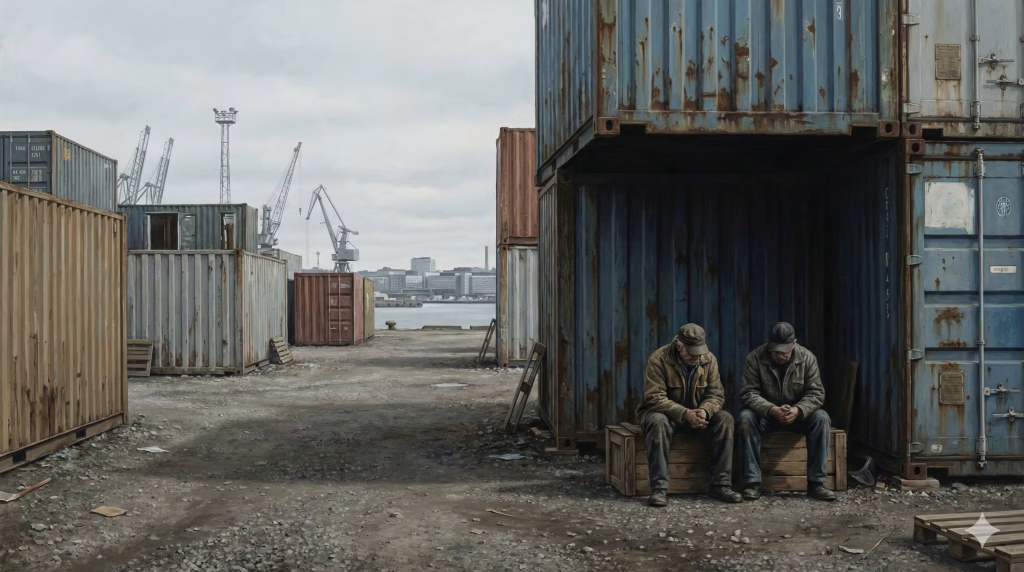
If Kallio is the city’s soul, the harbours and wastelands are its subconscious. In The Man Without a Past (2002), the memory-loss-stricken protagonist ends up living in a container village in Verkkosaari. This rugged urban landscape is a place beyond the gaze of official society, marking the margins of Helsinki.
Although the real container village and wastelands of Verkkosaari have since been swept away to make room for modern development, in the film they endure as spaces where an exceptional sense of solidarity prevails. A rusty container is transformed into a home, and potatoes are planted in the wasteland. Kaurismäki’s Helsinki is often at the edge of the world, where the sea is not a refreshing element, but a dark and oily border between civilization and freedom.
Bars and Cinemas as Sacred Spaces
Kaurismäkian humanism lives indoors: in dingy bars and classic cinemas. Restaurant Dubrovnik in Drifting Clouds (1996) or the Ritz on Museokatu in Fallen Leaves are sacred spaces where time stands still. They represent a vanishing sense of dignity and community.
In the real Helsinki, this aesthetic manifested for decades in Eerikinkatu’s Corona Bar and Kafe Moskova. These places were like sets that had leaped straight out of the movies: intentionally blunt service, dim lighting, and old jukeboxes. Even though many physical locations have changed or moved—such as Corona’s relocation to the Vallila Machine Shop—their spirit lives on as a form of resistance against modern “glass and steel.”
Aesthetics as a Form of Resistance
Kaurismäki’s Helsinki is a consciously limited construction. Smartphones, shopping malls, and clinical office buildings have no place in the director’s simulated reality. Kaurismäki employs an “aesthetic of deadpan understatement” and the soft, saturated light created by his long-time cinematographer Timo Salminen to transform everyday Helsinki into a timeless space.
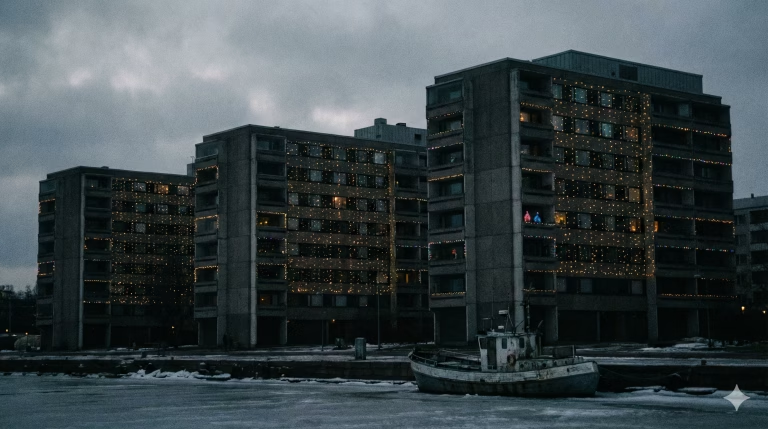
The result is not merely nostalgia, but also a critique of architecture. Modern Helsinki, such as the glass palaces of Ruoholahti in Lights in the Dusk (2006), is depicted as a cold and alienated prison. In contrast stand the old stone buildings and shabby backyards. They offer visual and spiritual shelter for people who do not fit into the mold of efficiency requirements.
Conclusion: A State of Mind Called Helsinki
Kaurismäki’s Helsinki is a humanist manifesto. It asserts that beauty is found in the rugged and dignity in silence. It is a city where one is allowed to be a failure and still retain their human worth. Although the physical filming locations become gentrified and change, the Helsinki created by Kaurismäki lives on in every dim corner table and in the autumnal light that falls upon an empty pier. A more humane and slower world is still possible to find—if only one knows which way to look.