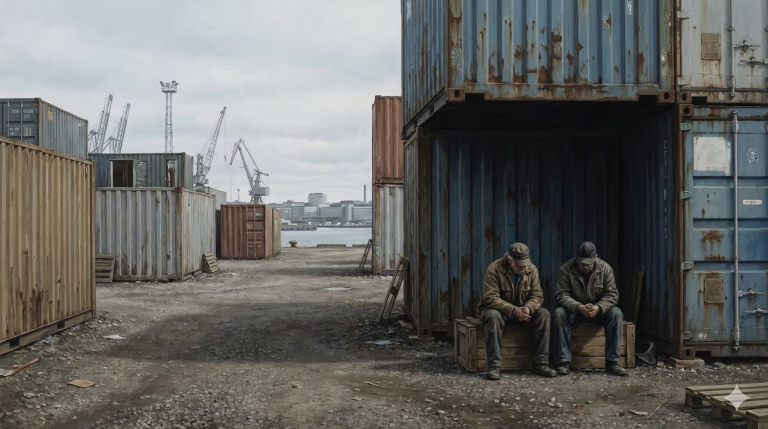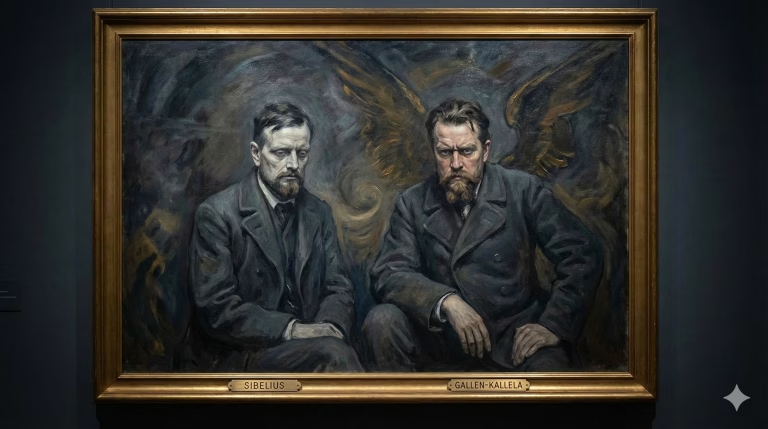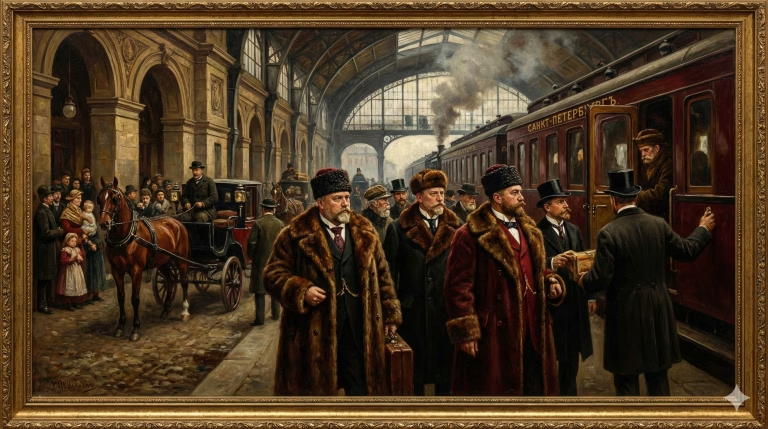
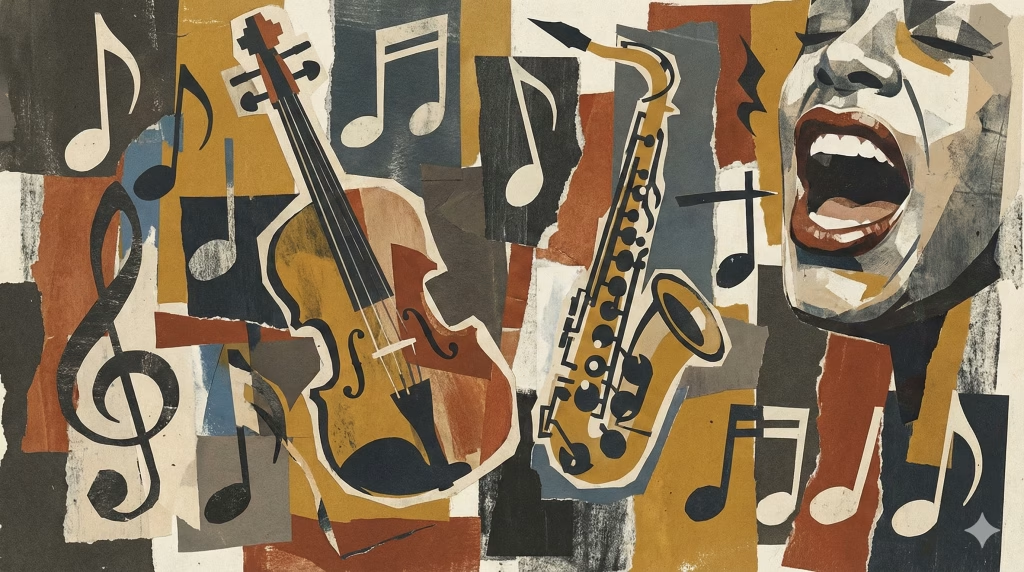
A slushy, grey mantle covered the streets of Helsinki, seeming to absorb all light. The heavy boots of the Imperial Guard clattered on the cobblestones of Aleksanterinkatu—rhythmically, but without soul. It was the only rhythm permitted. Ukase number 404, issued by the Russian Emperor who now ruled Europe, was absolute: “All harmonic, rhythmic, or melodic auditory stimulation, hereafter referred to as ‘music’, is strictly prohibited due to its harmful, destabilizing effects on brain activity and societal order.”
Elias pulled his collar higher and turned into an inconspicuous alley in the Kallio district. His heart was pounding—not from fear, but from anticipation. He was on his way to the “Cellar Club,” a place that didn’t officially exist.
The door was heavy and rusted. The knock was prearranged: two fast, a pause, three slow. Fibonacci numbers, Elias thought with a grim smile. A secret code based on nature’s own laws of growth. The door cracked open, and he was pulled into the gloom.
The air in the cellar was thick with tobacco smoke and suppressed tension. About a dozen people were present: former professors, conductors, neuroscientists. In the center of the room, under a dim lamp, sat Sofia, the group’s leading figure.
“Welcome, Elias,” Sofia said in a low voice. “We are just getting to the heart of the matter. Why do they fear us? Why does the Emperor fear this?” She tapped her finger on a shabby stack of papers lying on the table—forbidden research on the neurobiology of music.
“Because it’s hacking,” a young man in the corner said fervently. “They know it. Music isn’t just entertainment. It is a biological system that directly activates our mesolimbic reward system. When we listen to—or create—music, our brains release dopamine, the same substance linked to eating and sex. The Emperor wants to control our sources of pleasure. He cannot allow us to get ‘chills’ from something he cannot ration.”
”That is what the Emperor fears most: a crowd that knows each other without words”
Sofia nodded and continued. “But it’s not just about pleasure. It’s about power and cohesion. Do you remember Dunbar’s theory? Music evolved as ‘remote grooming.’ It is social glue. When a group of people moves or vocalizes in sync, their brains and physiological functions—heart rate, breathing—synchronize. It releases oxytocin, the bonding hormone. It makes the group cohesive and fearless. That is what the Emperor fears most: a crowd that knows each other without words.”
Elias sat down and joined the conversation. “It’s true. I’ve read Mehr’s research on credible signaling. Music requires time and coordination. It is an honest signal of a group’s strength. The Emperor’s army marches out of fear, but a singing nation would march out of a common will. It is an existential threat to totalitarianism.”
Silence descended on the room. The thought was revolutionary. Music wasn’t just aesthetics; it was an evolutionary survival mechanism.
“What about the connection to nature?” asked an older woman, a former physicist. “They have denied us 1/f noise.”
“Exactly,” Sofia replied, her voice rising with excitement. “Music sounds beautiful to us because it mimics the structures of nature. 1/f noise, or ‘pink noise,’ is the same structure found in heartbeats, coastlines, and the firing of the nervous system. Our brains are tuned to process these fractal structures fluently. When we hear music that follows this code, we experience ‘fractal fluency’—it feels like coming home. The Emperor wants us living in a sterile, artificial world, severed from our biology.”
Suddenly, the bang of heavy doors echoed from upstairs. The cellar lights flickered.
“They are here,” Elias whispered. Panic began to spread, but Sofia raised her hand.
“No,” she said firmly. “We do not run in fear. We use what we have studied. Remember predictive coding? Our brains are prediction machines. Music teaches us to tolerate uncertainty, to find pleasure when our expectations are violated and then resolved.”
Footsteps approached the cellar door. Sofia dug something out from the bottom of her bag that made the others’ eyes widen in terror and delight. It was a violin. Old, cracked, but intact.
“The HPA axis,” Sofia muttered as she quickly tuned a string. “Let’s lower cortisol levels. Boost immunity against fear.”
The door exploded open. On the threshold stood an officer of the Imperial Secret Police, the Okhrana, flanked by two soldiers armed with assault rifles.
“This gathering is illegal!” the officer roared. “You are accused of possessing material disruptive to brain activity.”
No one moved. Elias felt fear strangling his throat, but then Sofia raised the bow. It was madness. It was suicide.
She played a single, long note. It wasn’t just a sound. It resonated in alignment with the purest overtones of the harmonic series, a perfect acoustic phenomenon that struck directly at the listeners’ auditory cortex.
The officer flinched. His hand reached for his weapon, but the movement halted. The sound changed; it began to sway, creating a rhythm without drums.
”The motor areas of the brain had seized power from conscious control”
“Groove,” Elias thought. “Sensorimotor coupling.” He saw the soldier’s finger twitch on the trigger—not to fire, but in rhythm. The motor areas of the brain, the cerebellum and the supplementary motor area, had seized power from conscious control.
Sofia began to play a melody. It was simple, sad, and beautiful. It was full of “predicted surprises” that caressed the brain’s dopamine pathways. Something shimmered in the cellar air that the Emperor could not command: empathy. The music was activating their mirror neurons and limbic systems.
Elias began to hum along. Then another. Soon, the whole room was producing a low, resonant sound. It was musilanguage, the proto-form of language and music, bypassing semantic processing and striking straight at emotion.
The officer lowered his weapon slowly. On his face was an expression Elias hadn’t seen in years: confusion mixed with longing. The officer’s brain, accustomed to the rigid hierarchy of fear and control, was now bathing in oxytocin and endorphins. His stress levels collapsed, the cortisol washing away.
“It… it sounds…” the officer said, his voice trembling.
“Natural,” Sofia said, stopping playing but leaving the bow suspended in the air. “Because it is true. It is our species’ language.”
For a moment, there were no oppressors or oppressed in the cellar. There was only a group of Homo sapiens, their brains synchronized in the presence of a shared acoustic experience.
The officer swallowed hard. He looked at Sofia, then at his men, who looked as if they had woken from a long sleep.
“There is no one here,” the officer said quietly. He turned on his heel. “We will report the disturbance as a false alarm. A fault in the plumbing. Just noise.”
The door closed.
Silence returned, but it was no longer empty. It was full of potential. Elias looked at his hands, which were still trembling slightly—not from fear, but from frisson, the musical chills.
They had found a weapon against which the Emperor had no defense. They had found the biological code of humanity. And tomorrow, Elias knew, they would play louder.