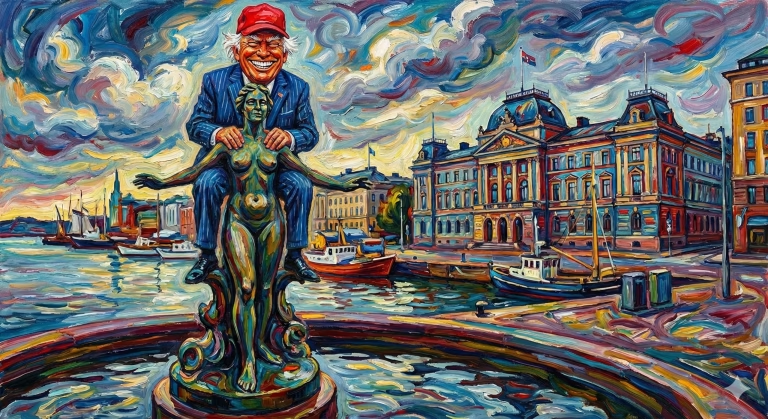
I stand in Senate Square and look at the statue of Alexander II. The wind blows from the sea—the same sea that has carried so many of this city’s sons and daughters out into the world.
Our schoolbooks and gala speeches tell us a story of a united nation, the Finland of Snellman and Mannerheim. But as I walk these streets, I sense a different kind of history. It is a history that whispers in archways and the lobbies of old stone buildings. History is also that which we have deliberately forgotten.
This is not a tale of those whose names are etched in granite, but of those whose names have been erased.
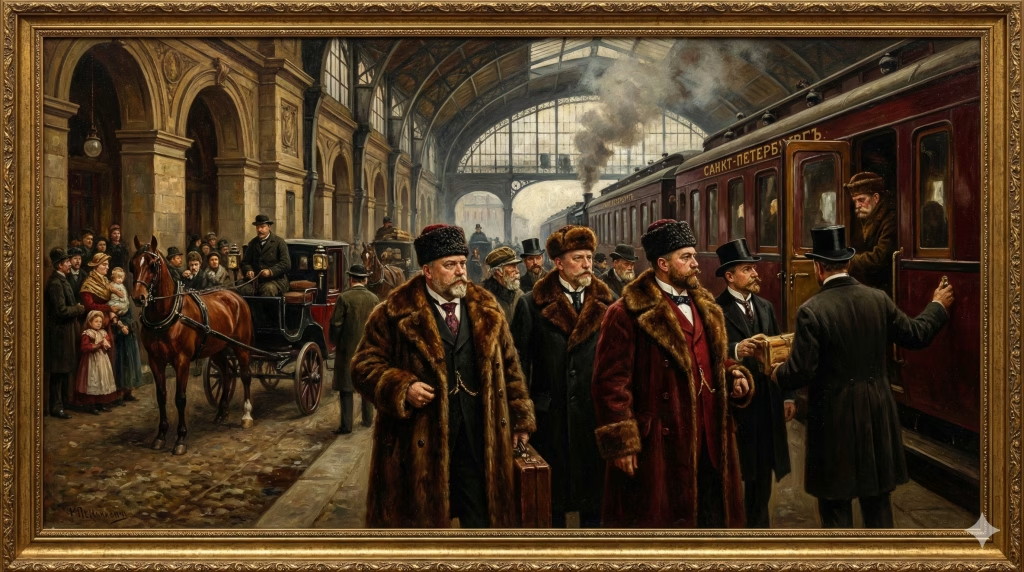
Passengers on the St. Petersburg Train
I walk down the Esplanade. I can almost see them boarding the train to St. Petersburg—those ambitious men whose gaze was fixed to the East, to the heart of the Empire. We have been taught to see them as servants of a foreign power, but to their contemporaries, they were the high achievers.
Consider Theodor Avellan. Here, he is but a name in a historical footnote, but in St. Petersburg, he was the man at whose desk the naval strategy for the entire Russian Empire was decided.
I imagine him standing on the bridge of a ship—not as a “Russian officer” in some pejorative sense, but as a Helsinki native who had risen to the peak of one of the world’s greatest powers. Or Admiral Oskar von Kraemer, the Tsar’s confidant, who walked the corridors of the Winter Palace with the same ease we walk the Market Square. They brought culture and wealth to this city, but the intoxication of independence and shifting political tides turned them into “unpersons.” Their sin was wrong timing and the wrong master.
And what of the hands that created beauty for the delight of Tsars? August Holmström and Henrik Wigström. A mason’s son and a master goldsmith born in Ekenäs, who forged the name of Fabergé into history. When I admire those priceless treasures, I see in them the hallmark of Finnish craftsmanship, even if the world knows them as Russian. They were part of that cosmopolitan network that made Helsinki the “antechamber of St. Petersburg”—a gateway where people traveled in both directions.
Intellectual Exile
An emptiness echoes in the university lecture halls. It is the absence of the voices we drove away. I remember the story of Adolf Erik Nordenskiöld—not the hero explorer celebrated by Sweden, but the young, fiery man who was banished from here because of a single dinner speech. We allowed political narrow-mindedness to drive away the man who opened the Northeast Passage.
The same pattern repeats later. Lars Ahlfors, a mathematical genius whose Fields Medal—the Nobel of mathematics—has a story like a thriller. The medal was smuggled out of the clutches of war and pawned in exile until it finally returned home decades later.
Or Edvard Westermarck, who sat in London writing the moral history of humanity while we here were arguing over language politics. They were too big for a small Finland, or perhaps we were too small to understand them.
Conscience and Oblivion
The most painful memory, however, concerns the year 1918.
The smoke of the Civil War had barely cleared when Hjalmar Linder, Finland’s wealthiest man, did something that money cannot buy: he spoke the truth.
“Enough of the carnage!” he cried out in the pages of Hufvudstadsbladet. I see him in his castle at Mustio, a lonely man who dared to look the victors’ vengeance in the eye and condemn it.
His reward was the label of a traitor and exile. Linder’s fate is a grim reminder that a community punishes most severely those who hold a mirror up to its face. His descent into oblivion was not an accident, but a collective defense mechanism.
Lost Splendor
As evening falls, the city lights flicker on, and my thoughts drift to the great stages of the world.
There, far from the slush of the Esplanade, Alma Fohström sang at the Metropolitan and Hanna Granfelt charmed Richard Strauss in Berlin. They were the superstars of their time, primadonnas in the truest sense of the word.
But the voice is fleeting, and when the curtain falls in a foreign land, the applause does not carry all the way home. We have forgotten them because their success happened elsewhere, in languages we did not speak, on stages we did not see.
Epilogue
An archaeological excavation into the city’s memory reveals layers we have covered with nationalism and simplifications. These people—diplomats, scientists, artists, and defenders of humanity—did not fit the mold we were building for ourselves.
But as I walk home, I feel their presence. I sense a Helsinki as it could have been: more international, more tolerant, bolder. History is a series of choices, and perhaps now, as we look back, it is time to choose to remember them too.
Without these forgotten stories, our image of ourselves is falsely incomplete.