Imagine a movie trailer. Explosions, clashing swords, a hero sprinting into fire. You know immediately what this is: a war movie. War is visual, kinetic, and easy to digest. There are good guys, bad guys, and a clear binary outcome: victory or defeat.
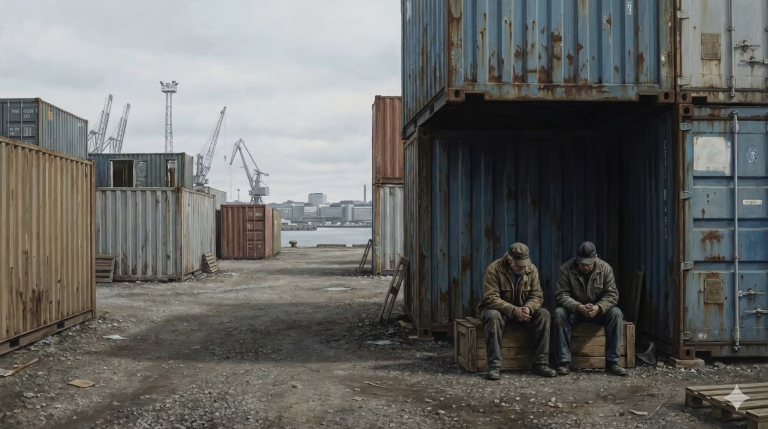
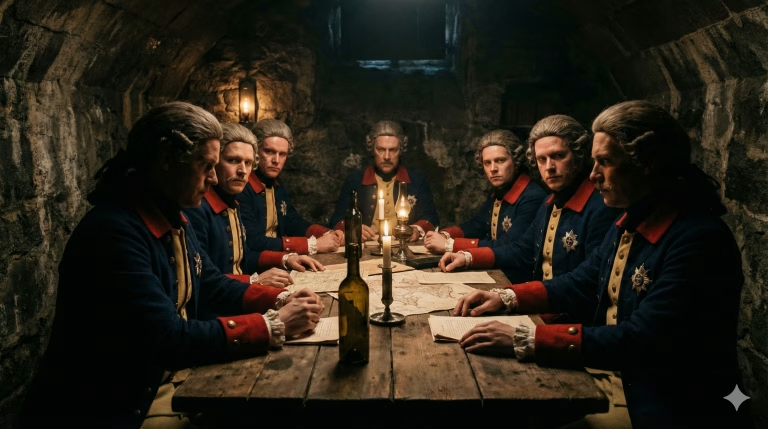
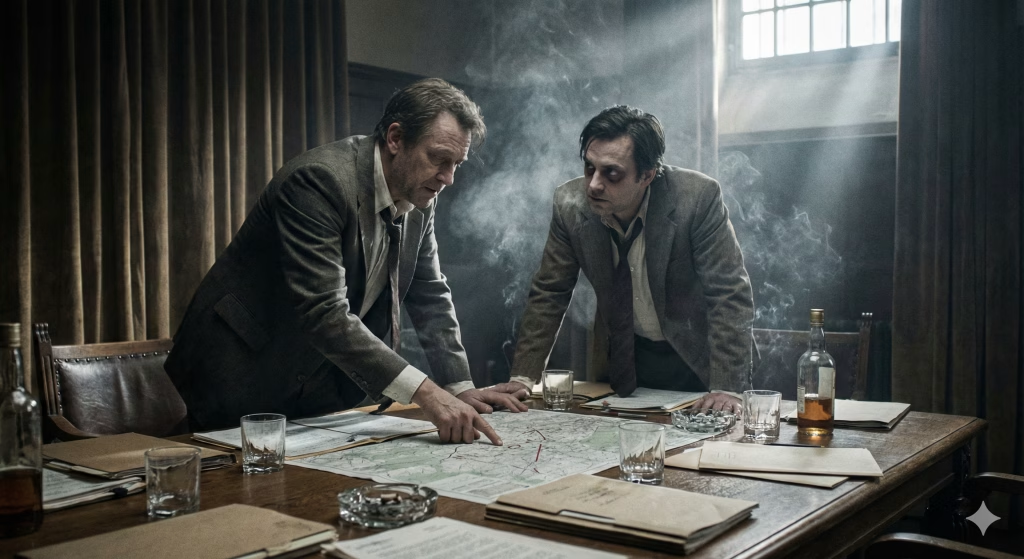
Now, imagine a different trailer. Two exhausted men sit in a dusty room. A stack of papers lies between them. One lights a cigarette and mutters, “Maybe we should rephrase paragraph four.”
It doesn’t sound like a box office hit, does it? This is the eternal challenge for filmmakers. Peace—or more accurately, peacemaking—is a process that is often slow, visually static, and intellectually complex. Yet, cinema history is peppered with masterpieces that have turned the “boring” bureaucracy of compromise into high-stakes thrillers.
A recent analysis of the “dramaturgy of peace” suggests that cinematic peacemakers are far from passive idealists. They are architects, gamblers, and sometimes, master manipulators.
Weaponizing Silence
Richard Attenborough’s Gandhi (1982) taught the world that a peacemaker can be a radical agitator. Ben Kingsley’s Gandhi isn’t just a gentle soul; he is a political genius using “moral jujutsu.”
When the British Empire responded with force, Gandhi responded by refusing to cooperate. The film demonstrates how this broke the symmetry of conflict: weapons are useless against an opponent who is not afraid to die but refuses to kill. This theme echoes in Selma (2014), where Martin Luther King Jr. strategically chooses his battleground to provoke the oppressor into revealing their brutality to the cameras. In these films, peace is not an absence of action; it is a weapon.
Dirty Hands for a Clean World
Perhaps the most surprising insight from peace cinema is that effective peacemakers are rarely saints. Steven Spielberg’s Lincoln (2012) and the Holocaust drama Schindler’s List (1993) introduce us to the pragmatic savior.
Lincoln doesn’t abolish slavery through high-minded idealism alone; he uses bribery, lies, and horse-trading. He delays peace talks to force a constitutional amendment through Congress. The film challenges the audience: is it acceptable to play a dirty game if the prize is the freedom of millions?
Similarly, Oskar Schindler and Paul Rusesabagina (Hotel Rwanda) use whiskey, cigars, and flattery as their arsenal. When civilization collapses, the hero isn’t the one with the biggest gun, but the one who can talk, bribe, and bluff to save lives.
Waffles and Whiskey: The Anatomy of Diplomacy
The tension of the Cold War has provided fertile ground for “cabinet thrillers.” Films like Thirteen Days and Bridge of Spies depict a world where a single wrong word could end humanity. In this context, a phone call or a secret back-channel meeting carries as much dramatic weight as a bombing raid.
But perhaps the most clinical look at the process itself is Oslo (2021), detailing the secret Israeli-Palestinian back-channels of the 90s. The insight of the Norwegian facilitators was simple: force the enemies to eat together. When negotiators shared whiskey and spoke about their children, the “enemy” stopped being a mythical monster and became a human being.
Peace as a Radical Act
These films teach us that peace is infinitely harder than war. War requires hatred and logistics; peace requires creativity, the tolerance of uncertainty, and the ability to see humanity in your enemy even when it feels impossible.
Next time you’re scrolling through a streaming service, skip the superhero spectacle. Watch Nelson Mandela unite a nation through rugby in Invictus, or witness Dag Hammarskjöld fight for the UN in Hammarskjöld. You might find that the negotiating table is actually the most dangerous and thrilling stage on earth.