1. Introduction: The City, Memory, and Supernatural Experience
Throughout its history, Helsinki has served as a stage for countless human destinies, political upheavals, and social transformations. This historical stratification is not only visible in the city’s architecture and town plan but also lives strongly in the city’s intangible cultural heritage – especially in ghost stories and urban legends. This extensive research report delves deep into Helsinki’s “shadow history” by analyzing stories of unexplained phenomena told over the centuries. The aim of the report is not to take a stand on parapsychological phenomena in their ontological sense, but to examine them as a cultural-anthropological, historical, and sociological phenomenon.
The research answers three key questions: What kind of narratives have been told in the city? How do these stories connect to real-world historical events and phenomena? Why do certain districts, such as Kruununhaka and Suomenlinna, emerge as concentrations of supernatural storytelling?
1.1 Theoretical Framework of the Research
Ghost stories are not born in a vacuum. They are a form of collective memory, a way to process community traumas, social tensions, and moral questions. As shown in cultural studies, stories of the supernatural have fascinated people throughout the ages, acting as a safe way to experience fear and excitement. Even more essential is their function as maintainers of community norms: stories have warned of dangerous places or socially undesirable behavior, such as infidelity or misconduct in office.
In the context of Helsinki, this tradition has transformed from an agrarian belief tradition into modern urban folklore. While in the countryside people feared getting lost in the forest (“metsänpeitto”) and nature spirits, in the city, institutions became the objects of fear and respect: bureaucratic offices, gentry homes, prisons, and theaters. Helsinki’s ghosts are often “civilized”: they are colonels, ladies, actors, and civil servants, reflecting the capital’s role as a center of administration and culture.
1.2 Data and Methods
This report is based on extensive material including historical archival data, folklore collected by museums, modern media reviews, and local historical accounts. A particularly significant role is played by data recorded by the Helsinki City Museum and the Finnish Literature Society (SKS), as well as stories documented by local actors such as the Governing Body of Suomenlinna. The analysis is qualitative and narrative, aiming to place individual stories into a broader historical context.
2. Historical and Sociocultural Landscape
Understanding Helsinki’s ghost tradition requires knowledge of the city’s history. The city has undergone several transformations: a small town under Swedish rule, the grand new capital of the Russian Empire, and finally the modern center of independent Finland. Each era has left its mark on the canon of ghost stories.
2.1 From Rural Heritage to Urban Legend
The original Finnish ghost tradition was strongly tied to rural life. Folk beliefs knew of poltergeists (“räyhähenki”), “liekkiö” spirits (children who died unbaptized), and the folk of the dead (“kalmanväki”). The deceased was expected to linger in the home sphere for 40 days after death, and haunting was often associated with unfinished business or unatoned crimes.
As Helsinki urbanized in the 19th century, this tradition began to change. Stories took on pan-European influences. The “White Ladies” and “Grey Ladies” of Central European castles found their way into Helsinki manors and Art Nouveau buildings. Ghosts became more individual; they were no longer just impersonal forces of death, but named historical figures or specific social archetypes, such as the “betrayed bride” or the “dutiful officer”.
2.2 Real-World Tragedies as Engines of Stories
A significant part of Helsinki’s ghost tradition stems from real historical traumas. Wars, epidemics, and violent deaths have created a foundation for stories that act as collective memorials.
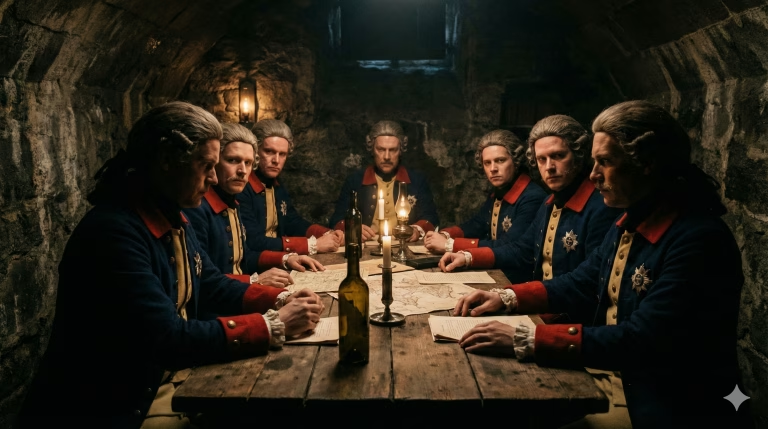
- The Finnish War 1808: The surrender of Viapori (Suomenlinna) and the beginning of Russian rule have spawned stories of betrayal and shame, personified as restless officers.
- The Civil War 1918: Red prisoner camps, especially in Suomenlinna, left a deep scar on the nation’s memory. The fates of prisoners who died of hunger and disease have transformed into stories of shadows wandering the area and an oppressive atmosphere.
- Epidemics: The Plague Park (Old Church Park) is a classic example of a place where the history of mass graves has created a permanent reputation as a haunted site.
3. Kruununhaka: Shadows of the Civil Servant City and the Aristocracy of Ghosts
Kruununhaka is one of the oldest and most prestigious residential areas in Helsinki’s city center. Its history as an administrative district, where the university, the senate, and the bourgeoisie have lived side by side, has created an exceptionally dense network of ghost stories. Kruununhaka stands out clearly from the rest of the city in the number of stories and their nature: here, ghosts are often high-ranking, and stories are set in massive stone buildings.
3.1 Vironkatu 1: Poltergeist Phenomena and the Mystery of Headless Aleksi
Vironkatu 1 is perhaps Helsinki’s most famous individual haunted house. The building has a varied history; it has served, among other things, as a Russian military warehouse and a department of the University of Helsinki. Today it is in residential use, but its reputation has persisted.
Range of Phenomena: The phenomena reported in the house are diverse and represent classic haunting imagery:
- Technological disturbances: Elevators are said to move by themselves between floors and doors open into emptiness, as if some invisible passenger were traveling in them.
- Physical displacements: During the university’s use, researchers reported that stacks of papers left in neat order in the evening were found spread across tables in the morning.
- Soundscape: Sounds resembling furniture being dragged have been heard from empty rooms, and unexplained knockings have targeted windows and pipes.
- Visual sightings: The most chilling tale relates to a woman who, while washing in the house’s shower facilities, saw a man dressed in an old-fashioned outfit beside her. The man was carrying his head under his arm.
Narrative Analysis: The ghost is known as “Headless Aleksi”, and two main versions of his story are told, reflecting the social history of Kruununhaka:
- The Officer Story: Aleksi was a Russian officer (or colonel) who fell in love with a woman living on Vironkatu. While escorting her home, he discovered she was already married or betraying him. Loss of honor and jealousy drove him to hang himself in the house’s attic.
- The Sailor Story: In another version, Aleksi was a sailor who returned home to Vironkatu from a long voyage, only to find his wife in the arms of another man. Tragedy followed immediately.
These stories are type examples of urban legends where homecoming and betrayal trigger a supernatural reaction. The lack of a head or carrying it under the arm is an international motif, often symbolizing sudden, violent death or shame (losing face).
3.2 Svenska Klubben: Gambling and Upper-Class Tragedy
Svenska Klubben on Maurinkatu is another cornerstone of Kruununhaka’s ghost tradition. The house represents the area’s noble and Swedish-speaking cultural heritage.
The Headless Colonel and the Grey Lady: Stories of Svenska Klubben often mix with those of Vironkatu, which is typical of oral tradition. The “Headless Colonel” is also told of here. In this version, the colonel was a passionate gambler who lost his fortune at the card table. Unable to face the shame and bankruptcy, he ended up committing suicide. His presence is said to manifest as the jingling of spurs in the corridors.
On the other hand, a “Grey Lady” has also been observed in the house. This figure is a calmer, melancholic apparition. She represents the bourgeois female image of the 19th century: restrained, but imprisoned by her emotions. The story of the Grey Lady is often less violent; she might be looking for a lost child or lover, or simply watching over the life of the house.
3.3 The Fire Chief’s House: Ghosts of the Common People
The Fire Chief’s House (Ruiskumestarin talo) on Kristianinkatu forms an interesting contrast to the stone palaces of Kruununhaka. Completed in 1818, the wooden house is the oldest wooden residential building in Helsinki’s city center. It represents the vanishing, wood-dominated Helsinki.
Sensory Perceptions and Dreams: The ghost stories of the house are more intimate in nature and less melodramatic than the officer stories. Residents have reported vivid dreams and a sense of presence. One resident described seeing a bluish-white female figure in a dream rising through the floorboards from the cellar chamber and being absorbed into her. The experience was combined with a strong sensation of a draft and coldness.
Historical Depth: Recent studies have revealed surprising layers in the house’s history. The builder of the house was a sailor’s widow, Christina Wörtin, and stories of Russian officers and inappropriate relationships are associated with the house. It is possible that ghost stories are a way to process these details left in the shadows of history, some perhaps scandalous. The house’s long-time owner and protector, Martta Bröyer, has also been mentioned as a possible spirit watching over the museumification and maintenance of her beloved home.
3.4 Sederholm House and Other Stone Houses
Sederholm House (built 1757), standing at the corner of Senate Square, is the oldest stone house in the city. Its status as the city’s oldest building makes it a natural magnet for ghost stories. Stories often focus on the attic and feature figures from the 18th century.
Additionally, the “Knife House” (Puukkotalo) is known in Kruununhaka, associated with a grim love triangle, murder, and suicide. Such “house-specific” tragedies are typical of densely built urban areas where walls are thin and neighbors’ lives are intertwined.
Summary of Kruununhaka (Table 1)
| Site | Location | Central Figure | Type of Phenomenon | Historical Reference |
|---|---|---|---|---|
| Vironkatu 1 | Kruununhaka | Headless Aleksi (officer/sailor) | Poltergeist, sounds, visual sightings | University history, Russian military warehouse. |
| Svenska Klubben | Kruununhaka | Headless Colonel / Grey Lady | Jingling of spurs, seeing a figure | Nobility’s gambling problems, suicides. |
| Fire Chief’s House | Kruununhaka | Blue-white woman / Martta Bröyer | Dreams, sensation of draft, knocking | History of common people, 19th-century living. |
| Sederholm House | Senate Square | Unknown 18th-century figure | Attic sounds, footsteps | Merchant bourgeoisie, 18th century. |
4. Suomenlinna: Isolation of the Islands and Echoes of War
If Kruununhaka is the home of civil servant ghosts, Suomenlinna (Viapori) is the realm of soldiers and prisoners. The geographical isolation of the islands, fortress architecture with its tunnels and walls, and bloody history make it one of Finland’s most significant ghost sites.
4.1 Piper’s Park and the Tragedy of Lemmenlampi (Pond of Love)
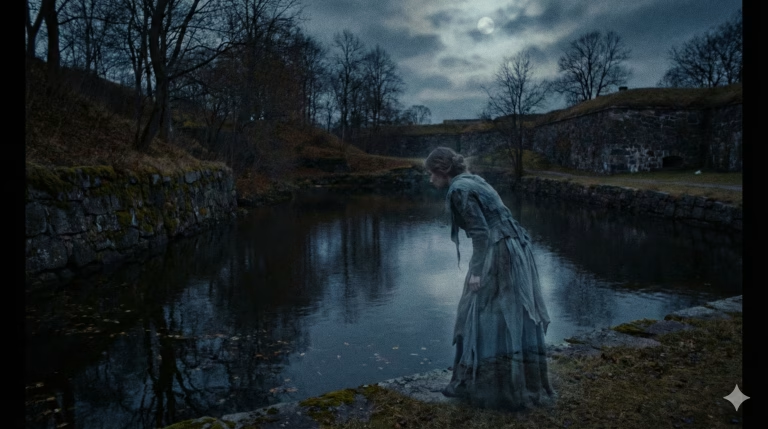
Piper’s Park on Susisaari was built in the 18th century, and at its center is a pond nowadays called Lemmenlampi.
Narrative: According to the story, a young woman and man lived in 18th-century Viapori and fell in love. However, their love was “inappropriate” regarding social class or otherwise against community norms (e.g., an officer’s daughter and a common soldier). Since they could not have each other in life, they decided to have each other in death. The couple tied themselves together and jumped into the pond to drown themselves. The man, wearing heavy clothes (or weights), sank to the bottom and drowned. The woman, however, wore a wide crinoline skirt fashionable at the time. The air trapped in the skirt acted as a float, and the woman remained on the surface. An officer or guard who happened upon the scene saved her. The woman survived, but broken and plagued by guilt. She is said to still wander in the park and by the pond, searching in vain for her lover whom she “betrayed” by surviving.
Analysis: This story is a classic example of folklore explaining a place’s name and atmosphere. It contains a Romeo and Juliet motif but adds a macabre, realistic detail (the floating effect of the skirt). The story reflects the rigidity of the 18th-century class society.
4.2 Bastions and Tunnels: The Architecture of Fear
Suomenlinna’s fortifications, such as Bastion Zander and the ramparts of Kustaanmiekka, are places where the physical environment itself feeds stories. Dark, echoing tunnels and massive stone walls create a state of sensory deprivation and acoustic illusions.
Phenomena:
- Bastion Zander: Sounds of footsteps, shadows, and a vague sense of anxiety have been reported here. As the fortress’s flag-raising site, it is symbolically significant, and the spirits “guarding” it are often perceived as patriotic protectors.
- Tunnel Network: The tunnel network running under the islands has been a source of numerous urban legends. There have been tales of a secret tunnel leading from Kaivopuisto to Suomenlinna (which is geologically and technically impossible in the 18th century), supposedly used by Russian officers for secret trysts.
4.3 The Legacy of the 1918 Prison Camps
Although many Suomenlinna stories are romantic or exciting, the island also has a darker, more hushed history. In 1918, after the Civil War, a prison camp operated on the islands where thousands of Red prisoners died of hunger and disease. This traumatic period has left a “heavy energy” in the area, which sensitive people describe as oppressive. While specific ghost stories often avoid this topic (focusing on 18th-century nobles), many experiences of unexplained sorrow and despair in certain buildings can be linked to this historical layer.
4.4 The Russian Era and the Susisaari Dockyard
The era of Russian rule (1809–1917) has also left its mark on the ghost tradition. In the Susisaari dockyard area and old barracks, stories are told of Russian soldiers and workmen. These stories remind us of a time when Viapori was part of the empire’s defense system, and life on the islands was multicultural and lively.
5. Public Buildings: Theatres, Hotels, and Restaurants
Public spaces are places where emotions run high and flows of people are large. It is not surprising that Helsinki’s most famous entertainment and cultural institutions are also homes to ghosts.
5.1 The National Theatre and “Axe-Urho”
The Finnish National Theatre is the stage for one of Helsinki’s most violent and well-known ghost stories.
The Case of Urho Somersalmi: Actor Urho Somersalmi (1888–1962) was a celebrated star of his time. However, his life ended in a shocking tragedy: he killed his wife, actress Aili Somersalmi, with an axe and then committed suicide. This is a real-world crime that has passed directly into folklore. According to the story, Urho has not left the theatre. His figure – sometimes with an axe – has been seen wandering the theatre corridors and the wings of the stage. He is known as “Axe-Urho” (Kirves-Urho). The story serves as a warning in the theatre community about the dark side of artistic genius and the dangers of passion.
5.2 Helsinki City Hall (Former Seurahuone)
The current City Hall on Pohjoisesplanadi previously served as Hotel Seurahuone. The building was a center of social life in the 19th century.
The Grey Lady: The City Hall’s ghost is the “Grey Lady”. There are several versions of her identity, but the most common is a woman belonging to the service staff or a nurse from the time of the First World War (a war hospital operated in the building). The Grey Lady is not scary, but caring. She hates drafts and carelessness. She is said to close doors, extinguish candles, and sometimes use the elevator. The story reflects the invisible role of the service staff: they kept the house running while alive, and do so even after death.
5.3 Alexander Theatre and Restaurant Kappeli
- Alexander Theatre: The old Russian theatre on Bulevardi is known for its restless soul, often associated with a Russian officer. He watches over performances and reacts if traditions are not respected in the theatre.
- Restaurant Kappeli: The ghost of Kappeli in the Esplanadi park has been identified as restaurateur Josef Wolontis. He is a benevolent spirit who “helps” the staff by moving furniture and supervising kitchen operations. Wolontis is an example of how a ghost story becomes part of a company’s brand and history.
6. Manors and the Periphery: On the Border of Countryside and City
As Helsinki expanded, it swallowed up old manors and villages. In these areas, the ghost tradition has retained more archaic features.
6.1 Tuomarinkylä Manor and the White Lady
A “White Lady” is said to haunt Tuomarinkylä Manor. She is believed to be Natalia Kavaleff, who belonged to the family that owned the manor. She has been seen in the manor park and attic. The White Lady is an archetypal manor ghost: noble, sad, and tied to the place. She represents the elegance and tragedy of a bygone world.
6.2 Lestimäki in Suutarila: The Horror of Justice
An execution site was located on Lestimäki in Suutarila in the 18th century. Although the execution site itself has vanished, the memory of the place (genius loci) has been preserved. Ghostly figures and an oppressive atmosphere have been reported in the area. This is an example of how violent history marks the landscape for centuries, even if physical signs are gone.
7. Real-World Explanatory Models and Intersections
The user’s question about real-world intersections is essential. Helsinki’s ghost stories are not mere imagination; they have a strong foundation in physical and historical reality.
7.1 Geological and Acoustic Factors
Helsinki is built on bedrock. The bedrock under the city (granite and gneiss) is an excellent conductor of sound.
- Vibration and Sounds: Vibrations and infrasounds caused by the metro, trams, and excavation work can travel along the bedrock for kilometers. When this vibration reaches an old stone house (e.g., in Kruununhaka), it can cause dishes to rattle or furniture to vibrate without apparent cause. This explains many poltergeist phenomena.
- Ventilation: Old gravity ventilation systems and drafty windows cause pressure changes that make doors slam shut by themselves (“The Grey Lady hates drafts”).
7.2 Psychological and Social Factors
- Pareidolia: The human brain is tuned to see faces and figures where there are none (e.g., shadows in a dim tunnel in Suomenlinna).
- Expectation Value: When a place has a reputation for being haunted (like Vironkatu 1), even small sounds are interpreted as supernatural.
- Social Control: Stories have acted as warning examples. The story of the cheating wife and the suicide officer on Vironkatu is a morality tale about the importance of fidelity.
7.3 Historical Truth
As stated earlier, many ghosts are based on real people (Somersalmi, Wolontis, Sederholm). Stories are a way to keep these people alive and process unresolved questions related to their lives.
8. Conclusions
This research shows that Helsinki’s ghost tradition is a living and dynamic part of urban culture. It is not stuck in the past but adapts to new spaces and times.
Key Observations:
- Regional Differentiation: Kruununhaka and Suomenlinna clearly stand out as concentrations of ghost stories. This is explained by their historical age, building stock (stone houses, fortresses), and social history (elite, soldiers).
- Narrative Continuity: Stories recycle international motifs (Headless Horseman/Colonel, White Lady) but plant them firmly in Helsinki’s soil and history.
- Connection to the Real World: Stories almost always have a connection to real historical events (wars, crimes) or physical phenomena (geology, acoustics).
Helsinki’s ghosts are fundamentally stories about ourselves: our fears, our values, and our way of remembering the past. As long as the city stands, its shadows will also walk its streets.
Table 2: Summary of Explanatory Models for Helsinki’s Ghost Phenomena
| Level of Explanation | Phenomenon | Example |
|---|---|---|
| Historical | Real tragedies and people | Urho Somersalmi’s murder-suicide, 1918 prison camps. |
| Geological | Sound conductivity of bedrock | “Poltergeist” and vibration in Kruununhaka stone houses (traffic, excavation). |
| Architectural | Draftiness, acoustics, materials | Sounds in Suomenlinna tunnels, creaking wooden floors in the Fire Chief’s House. |
| Psychological | Pareidolia, suggestion, fear | Seeing figures in dim light, effect of legend on experience. |
| Sociological | Moral education, community norms | Stories of betrayed husbands and punishments (Vironkatu). |
Source Articles
(The bibliography follows the original document, listing various sources from Mustekala, Helsinki City Museum, Finnish Literature Society, etc.)