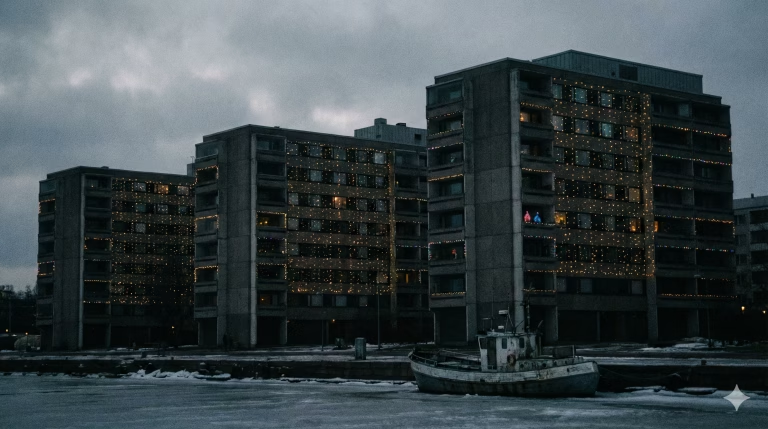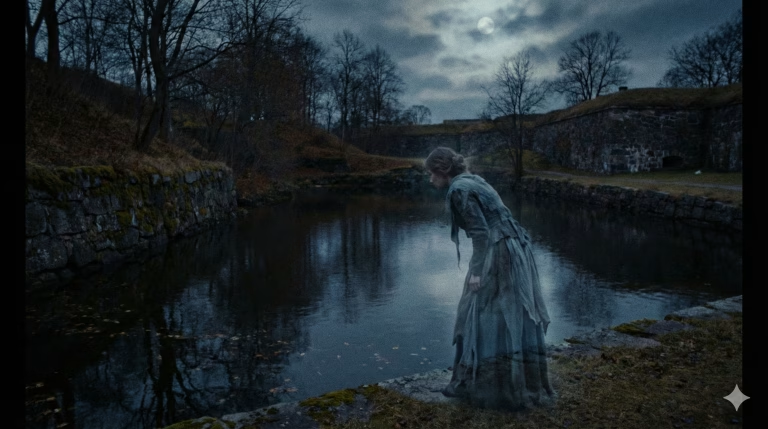
Finnish nationalism has undergone a complete transformation over the past century. At the end of the 19th century, it was a project of the intelligentsia, artists, and the liberal elite, aimed at elevating Finland among the ranks of civilized European nations. Today, national symbols have been harnessed for a different purpose: they are wielded by right-wing populists and anti-immigration movements who define themselves as a counterforce to the elite.
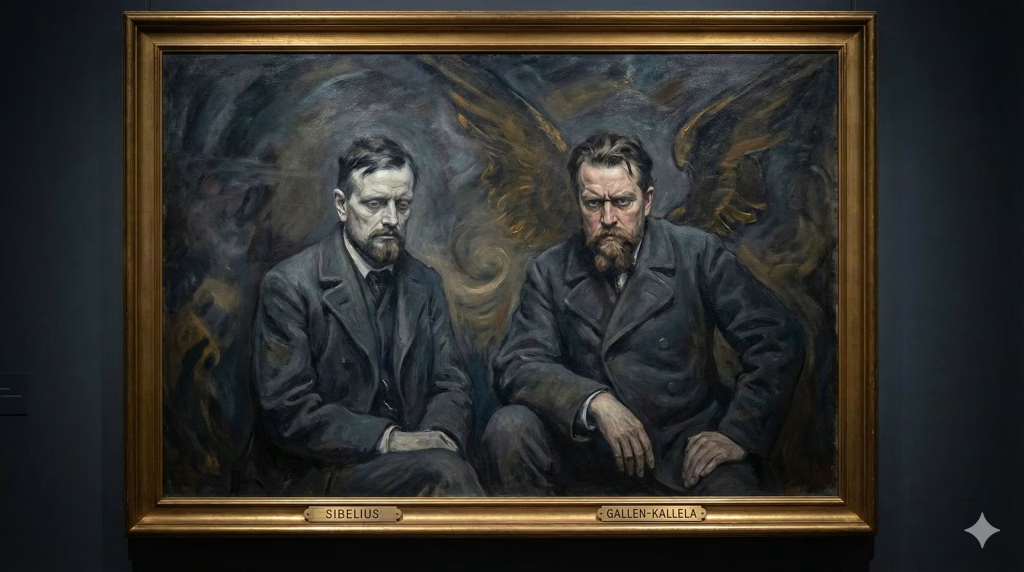
This raises a tantalizing question: If master composer Jean Sibelius and painter Akseli Gallen-Kallela lived in 2020s Finland, whose side would they be on?
The Liberal Elite of Hotel Kämp
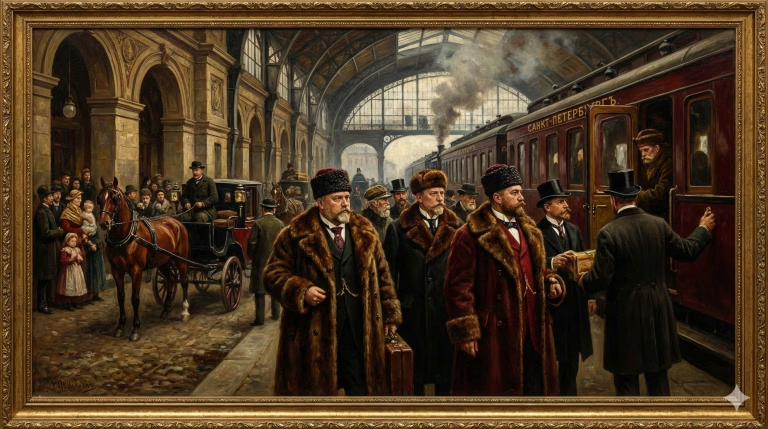
The image of Sibelius as a simple, birch-bark-shoe-wearing man of the people is a myth invented by later generations. In reality, Sibelius, Gallen-Kallela, and conductor Robert Kajanus formed the urban and international Symposium circle, whose headquarters was not a rustic smoke hut, but the luxurious Hotel Kämp.
They were the cultural elite of their time. They spoke foreign languages fluently, traveled to European metropolises, and often lived on credit to maintain their bohemian lifestyle. Politically, they were linked to the Young Finns (Nuorsuomalaiset), a liberal movement that emphasized constitutionalism, Western civilization, and connections to Europe.
If Sibelius lived today, he would unlikely be found among the “common folk” in a suburban pub. He would more likely be at a private club in Helsinki or in Berlin’s art circles, heatedly discussing the autonomy of art while enjoying expensive wines. He would be exactly the kind of “alienated elitist” today’s populists resent.
The Lion Pendant: From Ideal of Civilization to Gang Insignia?
For the artists of the Golden Age, the Kalevala was a source of creative inspiration—a well for universal human themes. To Gallen-Kallela, it represented a symbolist exploration of the human mind, not narrow nationalism.
Today, Kalevala jewelry and lion symbolism have been co-opted for a very different use. Far-right groups like the Soldiers of Odin use the Finnish lion as their insignia, defining Finnishness in narrow and exclusionary terms. For example, the “Sun Lion” (Aurinkoleijona) by Kalevala Jewelry, based on the historical Halikko treasure, has taken on new political meanings that its original designers—let alone the ancient Finns—would not recognize.
As a meticulous aesthetician with a keen interest in heraldry, Gallen-Kallela would likely be horrified by the vulgarization and politicization of his symbols. For him, form and civilization were sacred; degrading national symbols into tools for hate speech would be, to him, cultural vandalism.
Sibelius – A Green Influencer of Our Time?
Perhaps the clearest difference between the past and present lies in the relationship with nature. For Sibelius, nature was sacred. He drew his compositions from the rustle of the forest and the cry of the cranes.
In the 2020s, this deep connection to nature would inevitably translate into environmental concern. Climate change threatens the changing of the seasons and the very natural phenomena that were at the core of Sibelius’s art. His name is already used as a banner for environmental protection: Hämeenlinna has the “Sibelius Forest” nature reserve, and the Sibelius Academy of the University of the Arts Helsinki is committed to addressing the ecological crisis through art.
It is easy to imagine a modern-day Sibelius composing a commissioned work about the climate crisis or signing petitions for the protection of old-growth forests. In this, he would stand clearly in opposition to those political forces that downplay environmental action in the name of the economy.
Postmodern “Fake Art” and the Radicals of the Golden Age
In their political programs, the Finns Party has criticized contemporary art as “postmodern fake art” (tekotaide) and called for a return to traditional art that strengthens national identity.
Ironically, in their own time, Sibelius and Gallen-Kallela were specifically radical innovators. Sibelius’s Fourth Symphony was incredibly modern and stark for its time, and Gallen-Kallela boldly experimented with styles ranging from realism to expressionism. If they presented their works to today’s grant committees, populist cultural policies might reject them as “too difficult” or “unappealing to the masses.”
Contemporary artists, such as Iiu Susiraja with her grotesque self-portraits or Julia Strandman, who is working on the “Queer Kalevala” project (Marras), are actually continuing the tradition of the Golden Age: they are reinterpreting Finnishness through the lens of their own era, just as Gallen-Kallela did in his.
The Verdict: Cosmopolitans vs. Nationalists
If Jean Sibelius were to step out of his home, Ainola, in 2025, he would likely be a liberal global citizen. He would defend civilization, nature, and the freedom of art. To him, Finnishness would be open and European, not inward-looking and fearful.
It is a great historical paradox that the forces most loudly invoking Sibelius’s legacy as fuel for their nationalism would likely be alienated by the living Sibelius. To them, he would be too elitist, too international—and far too “green.”