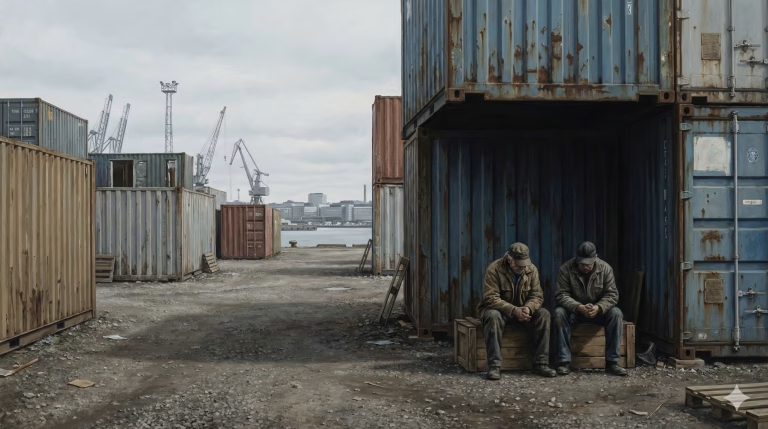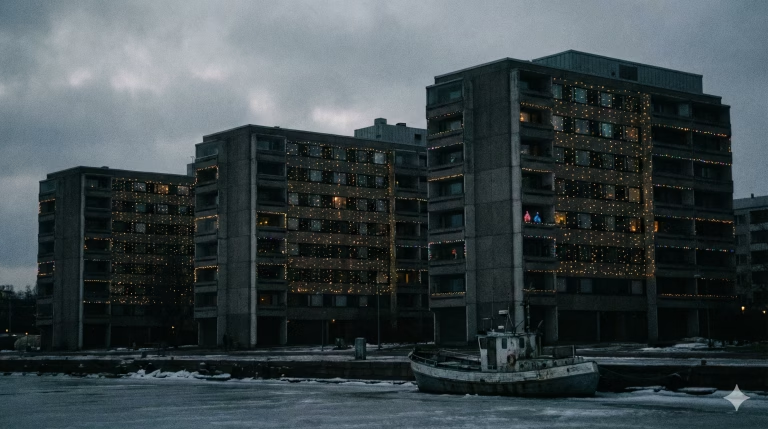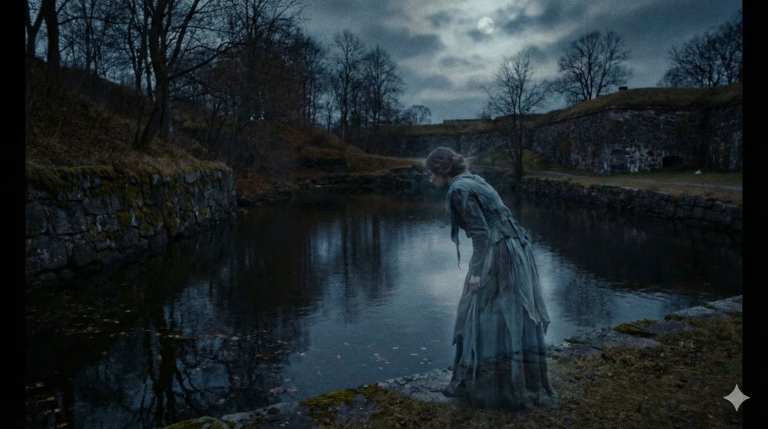

We are all in the same boat (or rather, the same puddle). December 2025 in Helsinki has been brutal. The sun has made an appearance for a grand total of about 20 minutes over the last month, and even then, it looked like someone turned on a low-battery flashlight inside a dirty wool sock.
On social media and at coffee tables, there is a collective consensus: This is hell. We are living in Mordor, but without the volcanic heat.
But allow me, my fellow sufferers, to ruin your martyrdom with science.
I got my hands on a fresh climatological comparative analysis where Helsinki’s November-December “extremity” was pitted against other inhabited corners of the globe. The result is a tough pill to swallow for a Helsinkian’s ego: Our misery is, on a global scale, embarrassing, mediocre, and downright boring.
Here are four places that are laughing at our “darkness.”
1. Tórshavn, Faroe Islands – When the Sun Rises, But No One Knows
In Helsinki, the sun shines a little bit in December. In Tórshavn, the sun is mostly a theoretical concept.
The capital of the Faroe Islands, Tórshavn, is located slightly further north than Helsinki, right in the middle of the North Atlantic storm highway. According to statistics, the sun shines in Tórshavn for an average of 0–1 hours in December. Not per day, but during the entire month.
While Helsinki’s darkness is caused by the sun setting early, Tórshavn’s darkness is “active darkness.” The sky is covered by such a thick, cyclonic cloud mass that even though the sun is above the horizon for five hours, its light simply cannot get through. Instead of fifty shades of grey, there is only one shade: pitch black.
A Helsinkian might see the sun occasionally in December. In Tórshavn, the probability of seeing the sun is 5%. For the remaining 95% of the time, the sky looks like wet concrete. It is the undisputed world champion of “weather misery.”
2. Bergen, Norway – When Rain Isn’t a Condition, It’s a Lifestyle
We complain that Helsinki is wet. “Boohoo, it’s drizzling again.”
Meanwhile, in Bergen, Norway, meteorologists are cracking up. In Helsinki, it rains an average of about 58 millimeters in December. That’s a decent amount, enough to get your pant legs wet.
In Bergen, it rains 290 millimeters in December.
Do you understand the difference in scale? Bergen gets five times more water in a single month than Helsinki does. That’s nearly 10 millimeters of water every single day. In Bergen, they don’t have “rainy days,” they have “rainy months.” If Helsinki’s weather is like a wet rag to the face, Bergen is like someone standing next to you throwing a bucket of ice water down your neck every hour.
Helsinki’s “wetness” is often slush floating on the ground. In Bergen, the water comes from the sky, and there is so much of it that umbrellas are considered disposable products.
3. St. John’s, Canada – Where the Weather Punches You in the Face
This one is my personal favorite. St. John’s in Newfoundland is a city that the weather gods hate with a passion.
We complain about the wind if it blows 5 m/s (approx. 18 km/h) in Helsinki. That’s a “draft.” In St. John’s, the average wind speed in December is double that, and storm gusts (over 90 km/h) are a daily occurrence. In 2025, they measured gusts that would have ripped the Pasila TV tower right off its foundations.
But the worst part isn’t the wind; it’s what the wind brings with it. St. John’s is the “sleet capital” of the world. In December, it gets 164 mm of rain AND 60 cm of snow. The weather changes in hours: first comes freezing rain that turns streets into ice rinks, then a 150 km/h storm, and finally a blizzard that buries your car.
In Helsinki, the weather is static wallowing. In St. John’s, the weather is a violent sport. Leaving the house there is an extreme discipline.
4. Adak, Alaska – The God-Forsaken Fog Island
If we combine the worst aspects of all the previous places, we get Adak, Alaska. It sits in the Aleutian island chain, in the cross-swell of the Bering Sea and the Pacific Ocean.
In Adak, a “sunny day” is a statistical error (probability in November: 1%). It rains over 200 days a year. It is always windy. And unlike in Helsinki, there is no Stockmann department store where you can go for comfort shopping. It is just wind, fog, and rain, with no hope of spring.
The Verdict: Helsinki’s “Misery” Is Actually Luxury
So, what is the conclusion of this masochistic trip around the world?
The report’s analysis hits the nail on the head: The “extremity” of Helsinki’s weather lies in its boredom.
Our suffering is static. We have a low cloud ceiling, light winds, and drizzle. It’s like living inside a Tupperware container. It’s not dangerous, it’s just numbing. It is the meteorological equivalent of lukewarm oatmeal.
In the reference cities (Tórshavn, St. John’s, Adak), the suffering is dynamic. There, the weather breaks umbrellas, knocks down trees, and washes roads away. It is terrifying.
So the next time you are walking down Mannerheimintie and the grey December drizzle fogs up your glasses, remember this:
You don’t have to hold onto a rope to stay upright (like in Punta Arenas, Chile). You don’t have to dive through a five-meter wall of water to get to the grocery store (like in Bergen). And you don’t have zero hours of sunshine per month (like in Murmansk).
You are just a little bored and grey.
On the world weather map, Helsinki is a “safe space.” It is dark, yes, but it is a soft, cotton-like darkness that isn’t trying to kill you. It’s just trying to get you to take a nap.Maybe we should be grateful? Well, maybe not that grateful. But at least we can take comfort in the fact that somewhere in the Faroe Islands, a local is looking out the window right now, watching a sheep fly horizontally past them, thinking: “Damn, I wish I lived in Helsinki. I hear it’s only a little bit grey there.”