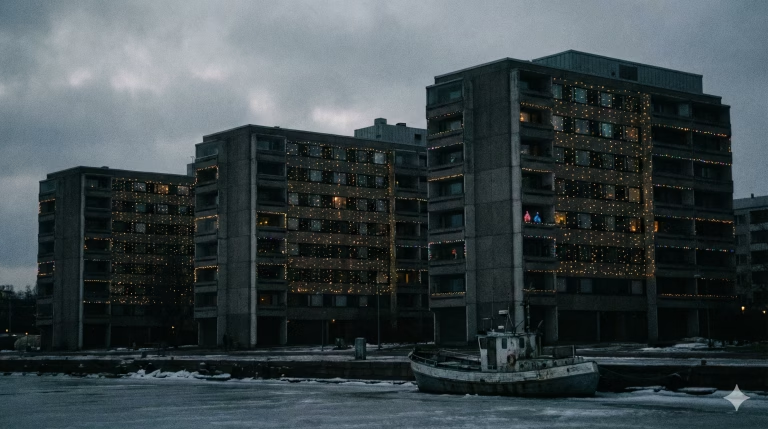

Helsinki has served as a central stage for international intelligence, state intrigues, and operational espionage throughout its history. The reason for this is the city’s location between the East and the West. The eastern outpost of the Swedish Empire developed into the “Casablanca of the North” during the Cold War and, over the decades, into the frontline of modern hybrid warfare. But why exactly is Helsinki a subject of constant interest for spies, and what is the goal of this invisible war?
Historical Layers: From the Surrender of Sveaborg to Okhrana Surveillance
Helsinki’s rise to the center of intelligence began with the construction of Sveaborg (Suomenlinna) in 1748. The fortress was intended as a military deterrent, but it was also a breeding ground for political discontent and separatist conspiracies.
Colonel Göran Magnus Sprengtporten of the Swedish Army represented an early historical influence agent who, on behalf of Russia, built plans to detach Finland from Sweden. The surrender of Sveaborg in 1808 was not a military defeat, but a successful psychological operation by the Russians, paved by Sprengtporten’s mole work, in which the defenders’ morale was broken by feeding them false information.
During the era of Russian rule (1809–1917), the Imperial secret police, the Okhrana, took root in Helsinki, with its activities foreshadowing modern mass surveillance. In “black cabinets,” citizens’ letters were opened, and block spies reported every suspicious movement. At the same time, Finnish activists, such as Konni Zilliacus, practiced counter-intelligence and even collaborated with Japanese intelligence to destabilize the Empire.
The Cold War’s “Casablanca of the North”
After World War II, Helsinki developed into a place where KGB and CIA agents could meet relatively freely. Finland’s neutral status made the capital ideal ground for information exchange and recruitment.
The Soviet Embassy on Tehtaankatu served as an operations center for the KGB and GRU, and Finnish politicians had their own “home Russians,” who acted simultaneously as communication channels and intelligence officers.
The Tiitinen list and the Alpo Rusi case still serve as reminders of how deeply the tentacles of espionage reached into Finnish society and how difficult it is to clean up these traces even decades later.
Present Day: Signals on Rooftops and Drones in the Sky
By the 2020s, espionage in Helsinki has changed its form but has anything but disappeared. When traditional human intelligence (HUMINT) became more difficult following the expulsion of significant Russian diplomats in 2022–2023, it was replaced by aggressive technical intelligence.
Antennas located on the roof of the Tehtaankatu embassy are believed to intercept official communications and mobile phone traffic in central Helsinki. At the same time, hacker groups like “Secret Blizzard” target state administration and researchers.
Observations of strange drones over power plants and the official residences of state leaders suggest that intelligence has moved from passive observation toward mapping potential sabotage targets.
Why Is Helsinki of Interest and What Is Targeted by the Activity?
Helsinki’s attractiveness as an espionage target stems from three main factors:
- Strategic location: Helsinki remains a key hub in the Baltic Sea region and a gateway to European Union and NATO secrets. The Herman Simm case—where he used Helsinki as a transit point for NATO documents—is a cautionary example of this.
- Information management and influence: Espionage does not only seek military secrets but also aims to influence Finnish political decision-making. It also seeks to silence critical research by “targeting” researchers and to gain a technological edge through corporate espionage.
- Grey area warfare: Nowadays, espionage is part of broader hybrid influence used to test Finland’s resilience. For example, GPS jamming in the Gulf of Finland is not just data collection, but active interference that causes economic damage and uncertainty.
Helsinki’s history as a stage for espionage shows that although methods have changed from secret letters to cyberattacks, the city remains on the frontline of superpower politics. The war of spies on Helsinki’s streets, in its cabinets, and in digital networks is continuous. Its ultimate goal is always the same: to weaken the opponent and ensure one’s own situational awareness in a changing world.