Introduction: A Granite Utopia and the Triumph of Engineering
When we examine Helsinki in 2050 – this pearl of the northern hemisphere standing guard at the border of the Baltic Sea and the Arctic – we cannot avoid drawing parallels to the imaginary worlds of the 19th-century visionary, Jules Verne. Verne, whose pen sketched the outlines of submarines, moon landings, and an electric society long before they materialized, would find a kindred spirit in the mid-century Helsinki. It is a city that has faced the climate crisis and the relentless constraints of its northern location not by submitting, but by harnessing them through engineering, courage, and scientific optimism.
Helsinki in 2050 is a living organism, a machine that breathes electricity and hydrogen. It is a realized utopia where Journey to the Center of the Earth meets Captain Nemo’s underwater kingdom and Robur the Conqueror’s mastery of the skies. But unlike Verne’s often solitary heroes who fled society into their technological fortresses, Helsinki has built its technology in the service of community, resilience, and survival. The northern dimension – extreme weather phenomena, darkness, and ice – is no longer an enemy, but a source of energy and architectural inspiration.
This comprehensive research report dives deep into the futuristic essence of Helsinki. We analyze the city’s metamorphosis through four Vernian elements: Earth (geology and underground urbanism), Water (maritime transport and floating structures), Air (transport and energy), and Fire (renewable energy and heat). The report is based on extensive data regarding urban planning, technological innovations, and the impacts of climate change, constantly mirroring them against the themes of Verne’s body of work. It is a story of a city that has written itself into the future with granite, steel, and light.
Chapter 1: Underground Helsinki – Journey to the Center of the Earth
In Jules Verne’s classic Journey to the Center of the Earth, the descent into the bowels of the earth was a journey into the unknown, full of dangers and prehistoric wonders. In Helsinki of 2050, however, the underground world is precisely calculated, a masterpiece of engineering that forms the city’s second, invisible half. This “Shadow City” is not just a reaction to the lack of space, but a strategic response to extreme conditions.
1.1 A Realm Carved in Granite: The Geological Backbone
Helsinki’s unique advantage is its bedrock – billions of years old, hard, and dense rock that offers an ideal platform for underground construction. By 2050, Helsinki’s Underground Master Plan has been implemented in its full extent. Hundreds of kilometers of tunnels and over 400 separate cavern spaces crisscross beneath the city, serving everything from logistics to leisure.
This underground infrastructure is a direct response to the ethos of “conquering nature” described by Verne. When winter storms rage on the surface, intensified by climate change, or when summer heatwaves turn streets into furnaces, the underground city offers a stable, geothermally tempered haven. The temperature of the spaces remains constant year-round, significantly reducing energy consumption for heating and cooling.
The most significant example of this is the evolution of the Itäkeskus swimming hall. Originally a two-story space carved into the rock capable of accommodating 1,000 swimmers or serving as a civil defense shelter for 3,800 people, it has served as a prototype for dozens of new facilities. In Helsinki of 2050, similar “hybrid caverns” can be found in every major district. They are not grim bunkers, but architectural miracles where fiber optics and reflective surfaces bring daylight deep underground, creating the illusion of an open sky – a technique Verne described in the lighting solutions of the Nautilus salon.
1.2 Twin Tunnels: FinEst Link and Hyperloop
If Verne had lived in the 21st century, he would undoubtedly have written a novel about the tunnel between Helsinki and Tallinn. By 2050, this “FinEst Link” has been realized, and it is the world’s longest underwater railway tunnel, clearly surpassing the dimensions of the Channel Tunnel. It is the Magnum Opus of engineering, connecting two capitals into one functional metropolitan area, “Talsinki,” with a population approaching two million.
The tunnel is not just a single tube, but a complex infrastructure corridor:
- Logistics Tubes: Cargo units based on magnetic levitation travel silently and frictionlessly deep beneath the seabed, removing heavy truck traffic from the surface.
- Passenger Capsules: Travel time has been compressed to under 20 minutes by utilizing Hyperloop technology, where capsules move in a near-vacuum at speeds approaching the speed of sound. This technology is a direct descendant of the projectile capsule in Verne’s From the Earth to the Moon – ballistic travel in a controlled tube.
The economic and social impacts are immense. The commuting area has expanded to a radius of 100 kilometers, and the data cable and energy grid running through the tunnel make the region one of the world’s densest digital hubs. In a Vernian sense, this is the overturning of geography: the sea no longer separates, but connects.
1.3 Geo-agriculture: Underground Gardens
One of the most fascinating features of Verne’s Nautilus was its self-sufficiency in food production. Helsinki of 2050 has taken this concept underground. “Arctic Farming” and vertical farming have moved from laboratories to industrial scale in old bedrock shelters and new, purpose-mined “agro-caves”.
In these spaces, protected from northern frost and pests, a significant part of the city’s required biomass is grown.
- Technology: The farms utilize hydroponics and aeroponics, where plant roots receive nutrients directly from mist – a method that saves up to 95% of water compared to traditional farming.
- Energy: Lighting is handled by narrow-spectrum LEDs optimized for photosynthesis. Heat is obtained from the waste heat of data centers, creating a perfect symbiosis between digital and biological production.
This “underground countryside” is a modern version of the mushroom forests in Verne’s Journey to the Center of the Earth, but as a scientifically optimized and productive ecosystem.
| Feature | Underground Helsinki 2050 | Verne’s Literary Counterpart |
|---|---|---|
| Location | Deep bedrock (Granite) | Volcanic crater / Caverns |
| Transport | Maglev, Hyperloop, Metro | Underground streams, Rafts |
| Energy | Geothermal, Waste heat | Electricity (Nautilus), Natural phenomena |
| Food | Vertical farming, Hydroponics | Seafood, Prehistoric mushroom forest |
| Purpose | Resilience, Space, Logistics | Exploration, Escape |
Chapter 2: The Electric Sea – Nautilus and Icebreakers
The sea has always been the pulsating heart of Verne’s work, the “living infinite,” as he described it in Twenty Thousand Leagues Under the Sea. Helsinki’s relationship with the sea in 2050 is more intense than ever. Climate change has altered the nature of the Baltic Sea – storms are more violent and sea levels higher – but the city has responded to this with technological aggression.
2.1 Autonomous Icebreakers: Leviathans of the New Age
Although global warming has shortened the ice season, arctic conditions have become even more unpredictable. Pack ice and sudden freezing spells require equipment capable of operating in extreme conditions. Finland’s icebreaker fleet, always a world leader, has undergone a complete transformation by 2050.
The new generation of breakers are direct descendants of Captain Nemo’s Nautilus. They are autonomous, AI-controlled vessels that no longer require a large crew.
- Swarm Intelligence: Breakers communicate with each other and the merchant vessels they assist via a real-time 6G network, optimizing routes based on ice thickness and weather forecasts with millisecond precision.
- Propulsion: As Nemo predicted, “water is the coal of the future.” These vessels do not burn heavy fuel oil. They operate on green hydrogen, ammonia, or methanol produced with wind power. Fuel cells generate electricity that turns 360-degree rotating propellers (azipods), allowing the vessel to move sideways or even spin in place – agility that even the Nautilus would have envied.
- Design: The double-acting hull design allows for icebreaking both bow and stern first. Steel has been partially replaced with composites and smart coatings that reduce friction and prevent ice adhesion – technology resembling the “seamless” hull structure described by Verne.
2.2 Floating Districts: Propeller Island Realized
One of Verne’s lesser-known, yet extremely relevant works for the 2050s is Propeller Island, where he described a massive, artificial island transporting its inhabitants across the Pacific. In Helsinki, this vision has been applied as a housing solution against rising sea levels and housing shortages.
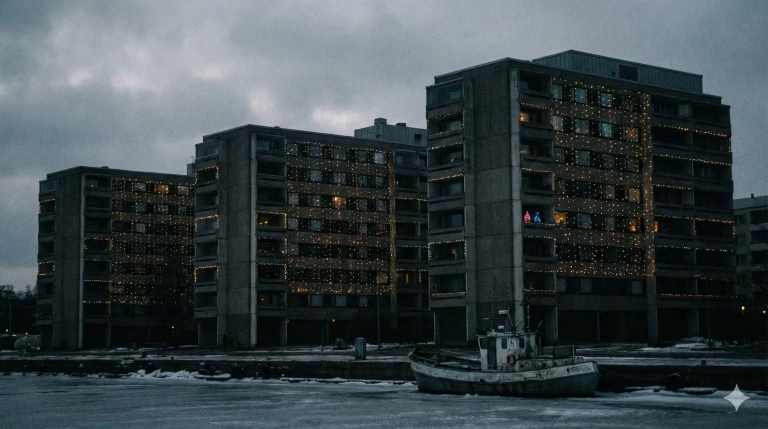
Floating blocks have risen in Helsinki’s coastal areas – off the shores of Jätkäsaari, Kalasatama, and Vanhankaupunginlahti. These are not merely houseboats, but massive, modular structures flexibly anchored to the seabed.
- Adaptation: When storm surges raise the sea level, these islands rise with the water. They are immune to the floods that threaten traditional coastal cities.
- Self-sufficiency: Floating communities produce their own energy with solar panels, wave energy converters, and seawater heat pumps. They recycle their water and waste in a closed loop. This is the utopia of Standard Island brought to a northern climate, but as a more democratic version – they are part of the city’s normal housing stock, not just escapes for millionaires.
This “maritime urbanism” changes Helsinki’s silhouette. Viewed from the sea, the city no longer ends at the shore but continues as an archipelago that lives and breathes with the waves. It is architecture designed to withstand water, not just to repel it.
2.3 Utilization of Seawater and Ecological Balance
Verne’s Nautilus was completely dependent on the sea, and so is Helsinki in 2050. Seawater is not just a thoroughfare, but a source of energy and raw materials.
- Heating and Cooling: Vast heat pump facilities absorb thermal energy from seawater into the district heating network in winter and use deep-sea cold for cooling data centers and properties in summer (solutions developed by Helen Oy and other actors have scaled massively).
- Underwater Mining: Verne’s Nautilus gathered treasures from the seabed. In Helsinki, seabed minerals and biomass (algae) are researched and utilized for the needs of the pharmaceutical industry and energy production, adhering to strict ecological criteria due to the fragile state of the Baltic Sea.
Chapter 3: Conquest of the Air – Robur the Conqueror’s Legacy
Jules Verne was a pioneer writer of aviation. In his works Five Weeks in a Balloon and Robur the Conqueror, he envisioned flying machines that were ahead of their time. In Helsinki of 2050, the sky is as busy a traffic lane as the sea or the underground tunnels. Airspace management is a critical part of the city’s logistics and transport.
3.1 Modern Airships in Arctic Logistics
The northern location and the melting of permafrost in Arctic areas caused by climate change have made traditional ground transport vulnerable. Maintaining railways and roads in the north is expensive and ecologically heavy. A solution has been found from the past, updated with 2050s technology: airships.
These are not the clumsy and dangerous zeppelins of the early 20th century, but streamlined “giants of the sky” built from composite materials.
- Technology: They use helium or safe hydrogen as lifting gas, and their propulsion is electric. The hull is covered with solar cells that generate energy during long flights in the nightless summer.
- Usage: Airships act as “flying trucks.” They transport heavy modules, wind turbine blades, mining equipment, and food from Helsinki to Lapland and the Arctic Ocean coast without the need for airports. They land vertically, making them ideal for servicing remote areas. Verne, who imagined Robur’s Albatross ruling the skies, would see his dream realized here: heavy traffic has been unshackled from the earth.
3.2 eVTOL and Urban Air Mobility
The fragmentation of the Helsinki peninsula and archipelago makes traditional cross-town traffic slow. In 2050, “Urban Air Mobility” (UAM) is everyday life. Electric vertical take-off and landing aircraft (eVTOL) serve as air taxis and express couriers.
- Vertiports: “Vertiports” – landing pads acting as aviation hubs – have been integrated onto the roofs of high buildings, such as the Pasila towers and Kalasatama skyscrapers.
- Integration: These vessels are connected as part of public transport. A passenger can order a ride that starts with the metro and continues with an eVTOL vessel to the archipelago. Drones transport medicines and urgent supplies between hospitals in minutes.
- Silence: Unlike Robur’s noisy propellers, the rotors of 2050 use biomimetic design (imitating the silence of owl wings) and active noise cancellation technology, making them nearly silent in the urban environment.
3.3 Weather Resilience and Measurement Technology
Northern weather – freezing drizzle, snowstorms, and high winds – places tough demands on aviation. Helsinki’s airspace is monitored and managed with the world’s most advanced weather systems.
- Micro-weather Forecasts: The city is full of sensors that model wind currents at the block level. Artificial intelligence guides drone swarms and eVTOL vessels to avoid gusts and turbulence in real-time.
- De-icing: Vessel surfaces are coated with superhydrophobic materials that prevent ice formation on wings and rotors without chemicals or high energy consumption – technology that has been developed in VTT’s laboratories for decades.
Chapter 4: Energy and Elements – The Mysterious Island’s Legacy
Perhaps the most profane prediction in Jules Verne’s body of work is found in The Mysterious Island (1874), where engineer Cyrus Smith states: “I believe that water will one day be employed as fuel, that hydrogen and oxygen which constitute it, used singly or together, will furnish an inexhaustible source of heat and light”. In Helsinki of 2050, this prediction is literally true.
4.1 The Heart of the Hydrogen Economy
Helsinki has completely detached itself from fossil fuels. The city’s energy system is based on wind, solar, and nuclear power, but their fluctuations are balanced by hydrogen.
- Electrolysis: When there is an oversupply of wind power (on stormy autumn days), the excess electricity is used to split water into hydrogen and oxygen in large electrolysis plants. The hydrogen is stored under pressure in underground rock caverns – the same granitic cavities that form the city’s foundation.
- Usage: Hydrogen serves as fuel for heavy transport, ships, and as backup power in the district heating network. Verne’s vision of “water as coal” has been realized: water is an energy carrier that circulates endlessly in the ecosystem without polluting it.
4.2 The Waste Heat Revolution: Data Centers as Furnaces
Verne’s Nautilus used electricity for everything, and its engines produced heat. In Helsinki, digital infrastructure is integrated into the physical heating system in a way that represents extreme efficiency.
- Mechanism: Large data centers, such as the facilities of Microsoft and other tech giants, are located underground or near residential areas. The massive amount of heat produced by servers is captured with liquid cooling and fed through large heat pumps into the district heating network.
- Scale: In 2050, up to 40% of Helsinki’s heating needs are met with this “digital heat.” Every time someone uses artificial intelligence or streams video, they indirectly participate in heating the city. This is circular economy at its best: data moves, and the heat generated as a byproduct keeps residents alive in the freezing cold.
4.3 Atmospheric Electricity: Hygroelectricity
Even more experimental, but developed in the spirit of Verne’s “mad scientists,” is hygroelectricity – harvesting electricity from atmospheric humidity. Helsinki’s high humidity and foggy conditions make it an ideal place for this technology.
- Nanomaterials: The facades of the city’s tallest towers and even street noise barriers are coated with porous nanomaterials (such as protein nanofibrils or zirconium oxide) that collect water molecules from the air. The movement of water molecules in the pores generates an electric charge.
- Passive Energy: This system generates electricity 24/7, regardless of the sun or wind. It is like the “electric soul” of Verne’s Nautilus, which drew power from the surrounding element. Although the power per square meter is small, vast surface areas make it a significant addition to the city’s microgrids.
Chapter 5: The New Human and Daily Life – Return of the Steam Men
In Jules Verne’s stories, humans often exceeded their physical limits with the help of machines. The Steam House introduced a mechanical elephant that transported travelers. In Helsinki of 2050, machines are not just vehicles, but are worn by people.
5.1 Exoskeletons: Strength for Care Work
The aging population has been a major challenge for Finland, but technology has answered the call. In care work and physically demanding professions, exoskeletons, or external support skeletons, have been widely adopted.
- Function: These wearable robots detect the user’s movements via nerve impulses or motion sensors and amplify muscle strength with electric motors. A nurse can lift a patient from a bed without back strain, and a construction worker can handle heavy elements as if they were feathers.
- Social Impacts: Technology has extended careers and improved quality of life. The elderly use lighter “active suits” that assist in moving and maintaining muscle tone. This is Verne’s dream of the symbiosis of man and machine, but brought to a human scale.
5.2 Smart Clothing: Adapting to the North
The Nordic winter is still cold, even as the climate changes. In 2050, clothing is high technology.
- S.E.T. (Smart Elastic Technology): Heating elements woven into clothes are no longer thick resistance wires, but flexible polymers integrated into the fabric. They adjust the temperature automatically according to the body’s heat production and the outside air.
- Materials: Aerogels, used by NASA as insulation, have been made into pliable fibers. A thin jacket corresponds in thermal value to a thick fur coat. Fabrics can also change their color or pattern electrically, enabling individual expression – a modern “steampunk” aesthetic where technology and style meet.
5.3 Bioluminescence: The Living City
In Verne’s Twenty Thousand Leagues Under the Sea, the depths of the ocean glowed with a mysterious light. Helsinki of 2050 has brought this phenomenon to the surface. In the name of energy efficiency and reducing light pollution, street lighting has undergone a biological revolution.
- Glowing Parks: Genetically modified plants and trees implanted with bioluminescent genes (e.g., from glow-worms or deep-sea organisms) line park paths on the Esplanade and in Central Park. They glow with a soft, blue-green light that is sufficient to guide the traveler but does not disturb nocturnal animals or sleep rhythms.
- Algae Lamps: Along the streets are pillars containing bioluminescent algae. During the day, they collect sunlight (photosynthesis) and bind carbon dioxide; at night, they glow. This creates a magical, Vernian atmosphere in the city, where the boundary between nature and infrastructure blurs.
Chapter 6: Architecture and Aesthetics – Neo-Jugend Renaissance
The aesthetic of Jules Verne’s era – steel, glass, rivets, and ornamentation – has made a comeback in Helsinki’s cityscape, but updated with 2050s materials. Helsinki has always been a Jugend (Art Nouveau) city, and this heritage has been refined into “Neo-Jugend” (Neo-Art Nouveau).
6.1 Granite and Organic Forms
The architecture of 2050 rejects the minimalist box architecture of the late 20th century. Buildings imitate the forms of nature (biomimetics).
- Stone Bases: The lower parts of buildings are still massive Finnish granite – rough, durable, and eternal. It anchors the city to history and geology.
- Superstructures: Rising above the granite are light towers built of wood and glass that curve and twist like plants. The undulating design language of the Oodi library has spread everywhere. Wood construction (CLT, LVL) is the prevailing norm due to carbon sequestration.
6.2 Steampunk Functionalism
Technology is no longer hidden but celebrated. Vernian “visible mechanics” are part of the cityscape.
- Waste Tubes: Pneumatic waste systems in Kalasatama and other areas transport waste underground at speeds of 70 km/h. The pipelines are partially left visible as transparent or metallic shimmering elements where waste bags can be seen flashing by – a reminder of the city’s metabolism.
- Materials: Copper, brass, and weathering steel (Corten) are popular facade materials. They patinate over time, telling the age and history of the building. Solar panels are integrated into these surfaces so that they look like decorative scales or leaves.
6.3 Amos Rex and Underground Aesthetics
The undulating square of the Amos Rex art museum was a pioneer. In 2050, many public spaces are “inverted”: the actual activity is underground, but on the surface, only sculptural skylights and domes are visible, bringing light down. This saves the ground level for parks and people, while creating an exciting, hilly landscape that invites climbing and hanging out. It is a city where the roof is also a floor and a park.
Chapter 7: Conclusion – The Future That Was Already Here
Helsinki 2050 is a paradox that would have delighted Jules Verne immensely. It is a city that is extremely technological, but whose technology strives to restore the connection to nature, not to sever it.
It is a city where:
- People travel underground in vacuum tubes faster than sound and live in floating homes on the sea.
- Ships travel on gas separated from water without a crew, breaking ice in prevailing silence.
- The glow of light comes from plants and heat from data hidden in the bedrock.
- Architecture combines granitic permanence with the organicity of wood and the lightness of glass.
In Verne’s visions, technology was often a means to break free from nature’s constraints, but also a means to admire its wonders from a safe distance. Helsinki of 2050 has removed that distance. The city itself is a Nautilus – a closed, self-sufficient, intelligent, and adventurous vessel sailing towards the future in the northern storms, carrying with it not just passengers, but an entire civilization.
This is Helsinki through the eyes of Jules Verne: bold, strange, and full of hope. It is proof that imagination is ultimately the strongest building material.
Table 1: Jules Verne’s Technological Predictions vs. Helsinki’s Reality 2050
| Verne’s Work / Technology | Verne’s Description | Helsinki 2050 Application | Technical Implementation |
|---|---|---|---|
| 20,000 Leagues Under the Sea / Nautilus | Electric, self-sufficient submarine. | Autonomous icebreakers and service vessels. | Fuel cells (H2), Azipods, AI control. |
| The Mysterious Island / Hydrogen energy | “Water is the coal of the future.” | Hydrogen economy, P2X (Power-to-X). | Green hydrogen from wind power, underground storage. |
| Journey to the Center of the Earth / Underground world | Caverns, mushroom forests, inner sea. | “Shadow City”, Underground Master Plan. | Swimming halls, Data centers, Vertical farms (Agro-caves). |
| Robur the Conqueror / Albatross | Multi-rotor aircraft, “ship of the air”. | eVTOL air taxis, Cargo airships. | Electric aviation, Silent rotors, Arctic airships. |
| Propeller Island / Floating island | Artificial, moving island for millionaires. | Floating districts (Jätkäsaari, Vanhankaupunki). | Modular pontoons, Wave energy, Seawater heat. |
| From the Earth to the Moon / Capsule | Cannon-based projectile capsule. | Hyperloop (Helsinki-Tallinn). | Maglev capsules in vacuum tube, >1000 km/h. |
| Paris in the Twentieth Century / Communication | “Electric writing”, faxes, remote news. | 6G networks, Holograms, Data centers. | Fiber networks, IoT, Waste heat recovery. |
Table 2: Helsinki’s Survival Strategy 2050 (Verne Analysis)
| Challenge | Traditional Solution | Vernian Solution 2050 | Impact |
|---|---|---|---|
| Sea Level Rise | Dams and levees | Floating cities and adaptive shores. | Flexibility, new living space on water. |
| Cold/Darkness | Fossil heating, streetlights | Smart clothing, Bioluminescence, Waste heat. | Energy efficiency, aesthetic experience. |
| Logistics (Arctic) | Trucks, ice roads | Airships, Hyperloop in tunnel. | Independence from bad road conditions, speed. |
| Food | Imports, greenhouses | Underground vertical farming (Geo-Agri). | Self-sufficiency, protection from weather phenomena. |
| Aging | Nurse staffing ratios | Exoskeletons, Robotics. | Human physical empowerment. |
Lähdeartikkelit
1. Jules Verne’s paradoxes of progress – Engelsberg Ideas, https://engelsbergideas.com/notebook/jules-vernes-paradoxes-of-progress/ 2. HELSINKI CITY PLAN, https://www.hel.fi/hel2/ksv/julkaisut/yos_2013-23_en.pdf 3. 2050 Scenarios: four plausible futures – Arup, https://www.arup.com/en-us/insights/2050-scenarios-four-plausible-futures/ 4. Check out Helsinki’s underground shadow city | Grist, https://grist.org/urbanism/2011-02-23-check-out-helsinkis-underground-shadow-city/ 5. 0-LAND_USE: UNDERGROUND RESOURCES AND MASTER PLAN IN HELSINKI, https://www.hel.fi/static/kv/Geo/CasePankki/0-LAND_USE.pdf 6. Underground Master Plan of Helsinki – A city growing inside bedrock – Appropedia, https://www.appropedia.org/w/images/7/79/Helsinki_underground_master_plan.pdf 7. Itäkeskus Swimming Hall – MyHelsinki, https://www.myhelsinki.fi/places/itakeskus-swimming-hall/ 8. Underground swimming pool in Itäkeskus, which can accommodate 1000… – ResearchGate, https://www.researchgate.net/figure/Underground-swimming-pool-in-Itaekeskus-which-can-accommodate-1000-customers-at-a-time_fig21_264982519 9. Inside Helsinki’s Underground Swimming Pool | AQUA Magazine, https://www.aquamagazine.com/builder/pools/article/15121938/inside-helsinkis-underground-swimming-pool 10. The Internal Layout of the Nautilus – The Vernian Era, https://www.vernianera.com/Nautilus/layout.html 11. Inside the Nautilus of Jules Verne: an internal arrangement for the famous sub – YouTube, https://www.youtube.com/watch?v=mpiG6YF026I 12. Greater Helsinki Vision 2050, https://www.safa.fi/wp-content/uploads/2019/12/ghv_www_protocol_english.pdf 13. Vision for Finland: – Future International Transport Connections, https://ek.fi/wp-content/uploads/2025/02/International-transport-connections-of-Finland.pdf 14. Pre-feasibility study Stockholm – Helsinki using HyperloopOne technology Short summary – KPMG International, https://assets.kpmg.com/content/dam/kpmg/pdf/2016/07/fs-links-pre-feasibility-study-summary.pdf 15. Arctic Farming revolutionizes food production with vertical farming technology for a greener tomorrow – Urban Tech Helsinki, https://urbantechhelsinki.fi/urban-farming/arctic-farming-revolutionizes-food-production-with-vertical-farming-technology-for-a-greener-tomorrow/ 16. Underground Food Farms as a Climate-Friendly Alternative Form of Urban Agriculture, https://www.mdpi.com/2071-1050/17/21/9392 17. Extract of the Helsinki Underground Master Plan (Image: Helsinki City… | Download Scientific Diagram – ResearchGate, https://www.researchgate.net/figure/Extract-of-the-Helsinki-Underground-Master-Plan-Image-Helsinki-City-Planning_fig14_264982519 18. Heat recovery service for data centers – Helsinki – Helen, https://www.helen.fi/en/companies/cooling-for-companies/Heat-recovery-service-for-data-centers 19. Twenty Thousand Leagues Under the Sea Quotes by Jules Verne – Goodreads, https://www.goodreads.com/work/quotes/1112418-vingt-mille-lieues-sous-les-mers 20. The 25 Best Twenty Thousand Leagues Under the Sea Quotes – Bookroo, https://bookroo.com/quotes/twenty-thousand-leagues-under-the-sea 21. Finnish Transport Infrastructure Agency to kick start the concept design for an icebreaker, https://valtioneuvosto.fi/en/-/25230764/finnish-transport-infrastructure-agency-to-kick-start-the-concept-design-for-an-icebreaker 22. STYRELSEN FÖR VINTERSJÖFARTSFORSKNING TALVIMERENKULUN TUTKIMUSLAUTAKUNTA WINTER NAVIGATION RESEARCH BOARD – Traficom, https://www.traficom.fi/sites/default/files/media/file/WNBR%2050%20Year%20Evaluation.pdf 23. Icebreaking Explained – Finland: Europe’s Icebreaker Superpower | Wilson Center, https://www.wilsoncenter.org/article/icebreaking-explained-finland-europes-icebreaker-superpower 24. Four concept designs to decarbonize icebreaking – Aker Arctic, https://akerarctic.fi/app/uploads/2023/02/Passion_news_2023_nro_01_pages_20-21.pdf 25. Propeller Island – Wikipedia, https://en.wikipedia.org/wiki/Propeller_Island 26. Reading Verne’s Voyages Extraordinaires (41): Propeller Island, aka The Floating Island : r/julesverne – Reddit, https://www.reddit.com/r/julesverne/comments/1fh7hof/reading_vernes_voyages_extraordinaires_41/ 27. Fast Forward: ‘Floating City’ offers urban solution to rising sea levels | ASCE, https://www.asce.org/publications-and-news/civil-engineering-source/civil-engineering-magazine/article/2024/01/floating-city-offers-urban-solution-to-rising-sea-levels 28. Inventive Finnish company makes construction ideas float – thisisFINLAND, https://finland.fi/business-innovation/inventive-finnish-company-makes-construction-ideas-float/ 29. Social and health impacts of exoskeleton use on care workers – PMC – PubMed Central, https://pmc.ncbi.nlm.nih.gov/articles/PMC12547050/ 30. Renewable Energy Breakthrough: Algae-Powered Streetlights Lighting Sustainable Public Spaces – Smart City Strategies & Solutions, https://www.smartcityss.com/resources/renewable-energy-breakthrough-algae-powered-streetlights-for-public-spaces 31. Airships Could Transform Logistics in Remote Areas of Russia’s Far North – RuAviation, https://ruavia.su/airships-could-transform-logistics-in-remote-areas-of-russias-far-north/ 32. Canadian North Signs Deal to Design Airship for Arctic Logistics – Blog, https://blog.gettransport.com/cs/canadian-north-signs-deal-to-design-airship-for-arctic-logistics/ 33. Mapping the Future of the Arctic, https://ftp.skolkovo.ru/web_team/iems/arctic2050_FINAL_WEB.pdf 34. Cargo Airship Strategy For Northern Canada – Canadian Arctic Innovation Association, https://arcticinnovation.ca/PDFS/2023-05-31_CAIA_Airship_Strategy_Northern_Canada_Arctic_Corridors_Final_V2.0.pdf 35. The Future of Urban Air Mobility in Helsinki – A new study out! – Interreg Baltic Sea Region, https://interreg-baltic.eu/project-posts/cityam/the-future-of-urban-air-mobility-in-helsinki-has-been-studied/ 36. URBAN AIR MOBILITY AND SUSTAINABLE URBAN MOBILITY PLANNING, https://urban-mobility-observatory.transport.ec.europa.eu/system/files/2023-11/urban_air_mobility_and_sump.pdf 37. Study on the Future of Helsinki’s Urban Air Mobility, https://marketplace.eiturbanmobility.eu/sites/default/files/files/insight/472c1708-6f0a-4c13-87d5-637ca419aefd.pdf 38. Urban Air Mobility into Helsinki Airport Case study Finavia – Theseus, https://www.theseus.fi/bitstream/10024/859996/2/Kinnari_Ilkka.pdf 39. THE LAUNCH OF ELECTRIC URBAN AVIATION – Eve – Air Mobility, https://www.eveairmobility.com/storage/2023/03/UK_Community_Benefits.pdf 40. Climate ChaNGe imPaCtS, adaPtatioN meaSUreS aNd vUlNeraBility aSSeSSmeNt, https://stat.fi/media/uploads/tup/khkinv/nc7_chapter_6.pdf 41. Weather and climate change risks in Helsinki – Helsingin kaupunki, https://www.hel.fi/static/liitteet/kaupunkiymparisto/julkaisut/julkaisut/julkaisu-32-19-en.pdf 42. Transportation industry – VTT Technical Research Centre, https://www.vttresearch.com/en/industries/transportation-industry 43. Water Will Be the Coal of the Future—The Untamed Dream of Jules Verne for a Solar Fuel, https://pmc.ncbi.nlm.nih.gov/articles/PMC6272904/ 44. Quote by Jules Verne: “Nearly, my friend.” “And what will they burn in…” – Goodreads, https://www.goodreads.com/quotes/10585756-nearly-my-friend-and-what-will-they-burn-instead-of 45. The Promise Of Green Hydrogen | Wood Mackenzie, https://www.woodmac.com/blogs/energy-pulse/the-promise-of-green-hydrogen/ 46. Hydrogen – Societe Generale Investment Solutions (Europe), https://investmentsolutions.societegenerale.lu/fr/esg/sustainable-solutions-thematics/hydrogen/ 47. Finland is emerging as a global leader in sustainable urban heating by repurposing waste heat from data centers to warm residential and commercial buildings. – ICMGLT, https://icmglt.org/finland-is-emerging-as-a-global-leader-in-sustainable-urban-heating-by-repurposing-waste-heat-from-data-centers-to-warm-residential-and-commercial-buildings/ 48. Finland Is Heating Entire Cities Using Waste Heat From Underground Data Centers — A Sustainability Masterclass – Delmer Group, https://delmergroup.com/blogs/news/finland-is-heating-entire-cities-using-waste-heat-from-underground-data-centers-a-sustainability-masterclass 49. Finland’s Big Idea: Turning Data Center Heat Into Power – YouTube, https://www.youtube.com/watch?v=NRQExK4mZrI 50. Here’s how data centre heat can warm your home – The World Economic Forum, https://www.weforum.org/stories/2025/06/sustainable-data-centre-heating/ 51. Realising a century-old dream to make electricity from air | Horizon Magazine, https://projects.research-and-innovation.ec.europa.eu/en/horizon-magazine/realising-century-old-dream-make-electricity-air 52. CATCHER: Harnessing atmospheric moisture to power clean energy revolution in the EU, https://catcherproject.eu/catcher-harnessing-atmospheric-moisture-to-power-clean-energy-revolution-in-the-eu/ 53. Exoskeletons can reduce strain also in health care | Tampere universities, https://www.tuni.fi/en/news/exoskeletons-can-reduce-strain-also-health-care 54. Exoskeletons and caregivers’ changing daily work | LUT University, https://www.lut.fi/en/projects/exoskeletons-and-caregivers-changing-daily-work 55. Towards Ethical and Sustainable Technology-Supported Ageing at Home in Finland – KATI Programme – CEUR-WS.org, https://ceur-ws.org/Vol-3069/FP_03.pdf 56. Reducing nurses’ workload with exoskeletons | University of Stavanger, https://www.uis.no/en/ethics-of-care/reducing-nurses-workload-with-exoskeletons 57. Discover the technology that revolutionised heated clothing – Therm-ic.com, https://www.therm-ic.com/blogs/news/the-set-technology-that-revolutionizes-warming-clothing 58. How Heat Generating Fabrics Work: Smart Heating Technology for Cold Weather Comfort, https://www.smartexyarn.com/blog/how-heat-generating-fabrics-work-smart-heating-technology-for-cold-weather-comfort/ 59. Heated clothing offers consumers new options | MAXHEAT Project | Results in Brief | H2020, https://cordis.europa.eu/article/id/428945-heated-clothing-offers-consumers-new-options 60. Living Light: Is There a Future For Bioluminescence Technology?, https://sensing.konicaminolta.us/us/blog/living-light-is-there-a-future-for-bioluminescence-technology/ 61. Bioluminescence: Nature’s light source shaping the future of sustainable lighting, https://wilderness-society.org/bioluminescence-natures-light-source-shaping-the-future-of-sustainable-lighting/ 62. Bioluminescent Urban Lighting – It’s Prodigy, https://www.itsprodigy.com/en/news/2025-05-29-bioluminescent-urban-lighting/ 63. Is Bioluminescence the future of public lighting? | Paysalia 2025, https://www.paysalia.com/en/blog/green-city/bioluminescence-public-lighting 64. Helsinki Art Nouveau architecture highlights – MyHelsinki, https://www.myhelsinki.fi/visit/helsinki-art-nouveau-architecture-highlights/ 65. Anne’s Pocket Guide to Helsinki Jugend Suomessa, https://anne-anderson.com/2022/11/22/annes-pocket-guide-to-helsinki-jugend-suomessa/ 66. Architecture of Helsinki: seven designs that define the city – Finnair, https://www.finnair.com/us-en/bluewings/destinations/architecture-of-helsinki–seven-designs-that-define-the-city-3018496 67. Finland: Helsinki’s Attractive Art Nouveau Architecture – Minor Sights, http://www.minorsights.com/2019/02/helsinki-art-nouveau.html 68. Helsinki Central Library Oodi topped with translucent “book heaven” – Dezeen, https://www.dezeen.com/2019/01/10/helsinki-central-library-oodi-ala-architects/ 69. Helsinki’s New Living Room— Oodi Library, https://www.amscan.org/wp-content/uploads/2021/09/SR-Spring-2021_Oodi_Library.pdf 70. Oodi’s architecture, http://oodihelsinki.fi/en/what-is-oodi/architecture/ 71. Helsinki Central Library Oodi is a masterpiece of roof construction – BMI Group, https://www.bmigroup.com/our-solutions/roof-project/public-buildings/helsinki-central-library-oodi-is-a-masterpiece-of-roof-construction/ 72. A small smart city in Finland shows the way on sustainability, https://www.sustainability-times.com/cities/a-small-smart-city-in-finland-shows-the-way-on-sustainability/ 73. The City of Helsinki’s Action Plan for the Circular and Sharing Economy, https://circulareconomy.europa.eu/platform/en/strategies/city-helsinkis-action-plan-circular-and-sharing-economy 74. Underground, overground at the Amos Rex – ubm magazin., https://www.ubm-development.com/magazin/en/underground-overground/ 75. Amos Rex JKMM Architects, http://world-architects.com/en/jkmm-architects-helsinki/project/amos-rex 76. Inside Helsinki’s New Underground Art Museum, https://www.afar.com/magazine/inside-helsinkis-new-underground-art-museum 77. Amos Rex’s bulging galleries create playful landscape in Helsinki plaza – Dezeen, https://www.dezeen.com/2018/08/27/amos-rex-gallery-art-museum-jkmm-architects-helsinki/