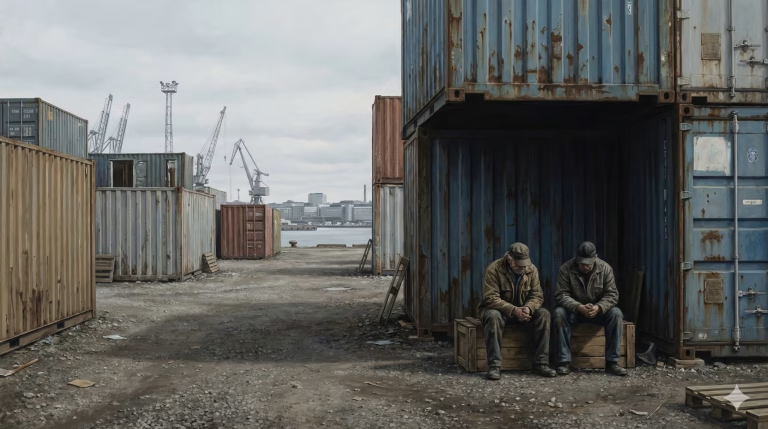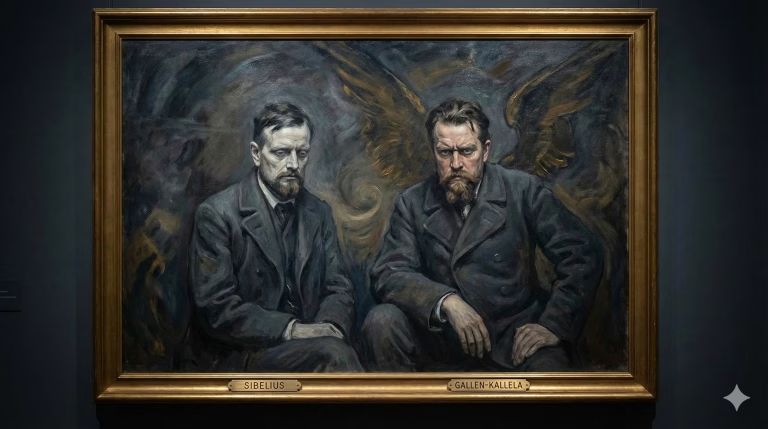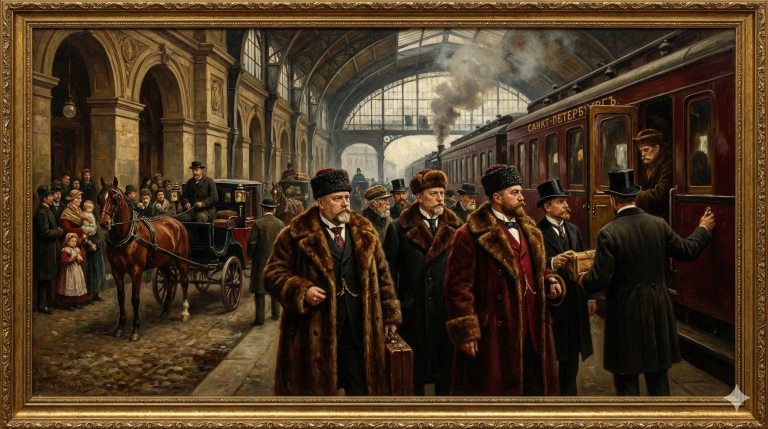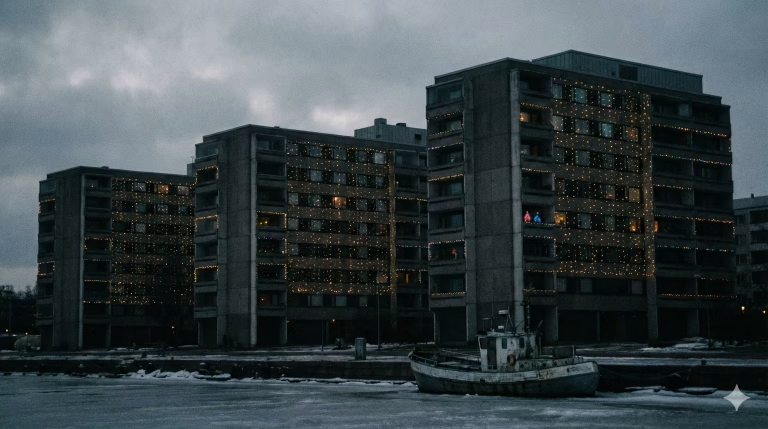
Helsinki is a city of light and the sea, but when the twilight of November descends or fog rises over the ramparts of Suomenlinna, it opens a route to another reality. In the Helsinki of stories, the past has never completely stepped aside for the present. We have compiled experiences of the unexplained from Helsinki residents in this article – as well as an expert’s analysis of what these phenomena are actually about.
Voices from the Darkness – Contemporary Accounts
The following stories are reconstructions created by the editors, based on Helsinki’s most famous ghost legends and observations reported about them.
Case 1: “He Does Not Carry His Head in Vain”
Location: Vironkatu 1, Kruununhaka
“I moved into the building knowing nothing of its history. The first weeks were peaceful, but then it started. At first, it was just small things – a stack of papers I had left on the table in the evening would be scattered on the floor in the morning. I thought I was just careless myself or that a draft did it.
But the sounds were harder to explain. Late at night, when the traffic had quieted down, heavy shuffling could be heard from upstairs. Just as if someone were dragging an old, massive oak chest along the parquet floor. I knew the upstairs apartment was empty due to renovations.
The worst part, however, was that one evening in the basement. I was taking down laundry when I felt that I was not alone. The air cooled suddenly. I glanced to the end of the corridor and saw a figure. It was a man, dressed in an old-fashioned way, perhaps in some uniform. But what made my blood run cold was his posture. His shoulder line was unnatural, and he was holding something under his arm. It took a moment to realize that his neck ended in nothingness. I never went there alone again.”
Case 2: Guilt That Won’t Drown
Location: Piper’s Park, Suomenlinna
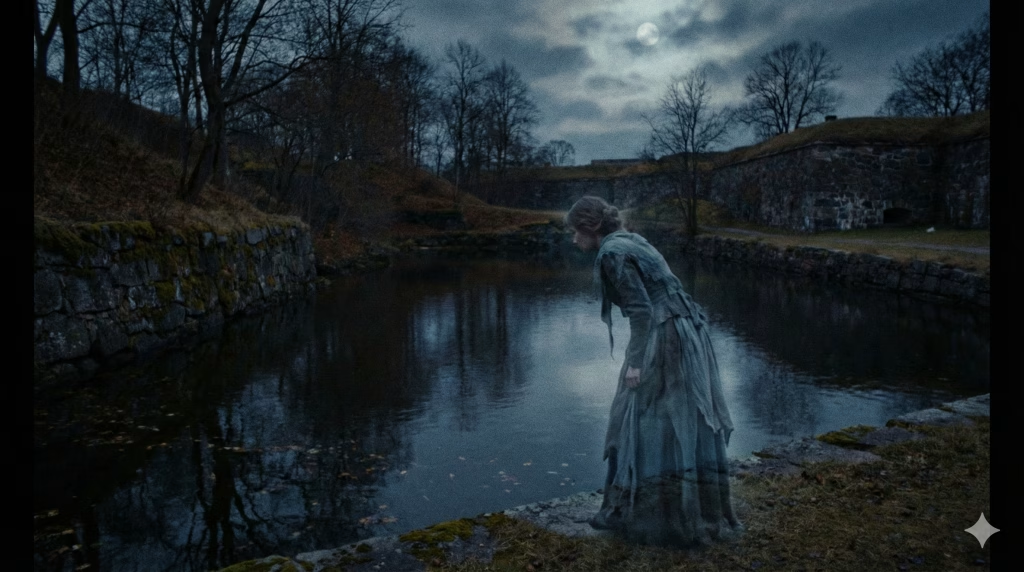
“I have always enjoyed being in Suomenlinna; it is a place of peace for me. But one autumn evening, I walked to the pond in Piper’s Park, the one called the Love Pond. It was completely calm.
I sat on a bench and looked into the water. Suddenly I felt an immense, crushing sorrow. It wasn’t my own feeling – I had had a good day. That feeling rolled over me like a wave. Then I saw her out of the corner of my eye. A woman’s figure, standing right at the water’s edge. She was wearing something wide, like an old skirt, that floated around her.
She seemed to be looking for something in the water. Her presence was so full of despair that I had to turn my gaze away. When I looked again, the shore was empty. Only the surface of the pond rippled, even though there was barely any wind. Later I heard the story of a couple who tried to drown themselves together, and of the woman who was cursed to live when her skirt prevented her from sinking under the surface.”
Case 3: The Final Act
Location: The Finnish National Theatre
“Things always happen in the theater, but the Main Stage has its own rule: do not stay alone in the dark. I was working at the scenery workshop and stayed late to finish some sets. The auditorium was dark, only work lights were burning on the stage.
I heard footsteps from the side stage. They were determined, heavy footsteps. I shouted, ‘Is anyone there?’, but no one answered. Then I saw a man’s silhouette in the shadow of the wings. He stood completely motionless and stared at me. He had something in his hand that looked… well, like an axe.
It didn’t feel threatening towards me, but rather like he was angry at himself or the world. I felt a cold draft pass through me, even though the air conditioning was off. I packed my things in record time. The older actors just nodded when I told them about it: ‘It’s just Urho watching over the place,’ they said.”
The Light of Reason – Expert Analysis
How can the experiences described above be explained rationally? According to a study familiar with Helsinki’s ghost tradition, the background of the phenomena is a mixture of geology, history, and the human mind’s ability to believe in imaginings.
Bedrock and City Sounds
In old stone buildings in Helsinki, so-called poltergeist phenomena are experienced: dishes rattle, furniture vibrates, or doors open by themselves. The explanation is usually found under our feet. Helsinki is built on bedrock – granite and gneiss – which is an excellent conductor of sound and vibration.
When the metro, a tram, or an excavation site causes vibration even kilometers away, the energy can travel along the rock and discharge into the structures of an old house. The massive stone houses of Kruununhaka act like resonance chambers: they amplify underground vibration, which can create the illusion of objects moving on their own. Old gravity-based ventilation systems and drafty windows also create pressure changes that slam doors shut – a phenomenon that in folklore has been named the work of the ‘draft-sensitive Grey Lady’.
Traumatic History and Collective Memory
Helsinki’s ghost stories are not random. Behind them are, almost without exception, real historical tragedies. They act as collective monuments to events that have been difficult to process.
- Vironkatu 1: The building has a history as a Russian military warehouse, and the stories of ‘Headless Aleksi’ (an officer or sailor) reflect the fears of 19th-century class society regarding loss of honor and infidelity.
- Suomenlinna: The island’s reputation as a haunted place is explained by its bloody history. In the prison camps of 1918, thousands of people died of hunger and disease. This national trauma has left the area with a ‘heavy energy’ that sensitive people still sense as anxiety. The story from Piper’s Park about a drowned lover is, for its part, a classic cautionary drama about unequal love.
- National Theatre: ‘Axe-Urho’ is based on a real historical event. Actor Urho Somersalmi killed his wife and himself in 1962. This real-world tragedy was so shocking and difficult to handle that it transferred directly into the folklore of the theater community.
The Brain and Expectation
Finally, the role of the human mind must be noted. Our brains are programmed to find meanings and faces (pareidolia) in random stimuli. In a dim tunnel in Suomenlinna, the brain easily interprets the movement of a shadow as a figure, especially if the passerby has already heard of the place’s reputation for being haunted. Social control is also a strong factor: stories have traditionally warned the community against breaking norms, such as infidelity or misconduct in office, by creating deterrents.
Helsinki’s ghosts are thus fundamentally our own history – told in the language of fear and mystery. They are a way to keep the past alive, remind us of old injustices, and explain that which we do not immediately understand.